
Breaking news
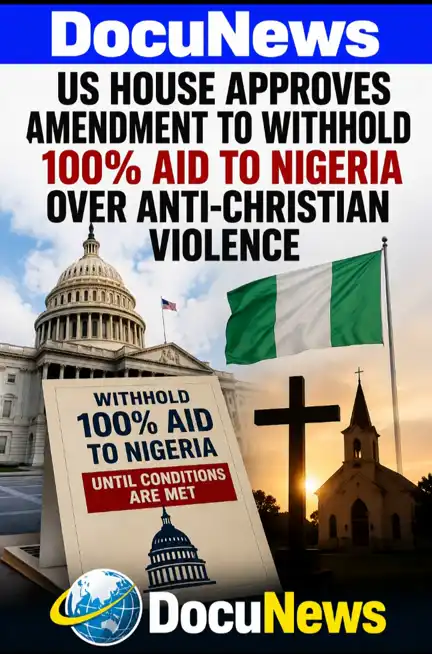
US House Approves Amendment to Withhold 100% Aid to Nigeria Over Anti-Christian Violence

Date: July 16, 2026
The United States House of Representatives has taken a significant step in its consideration of future foreign assistance to Nigeria, as lawmakers approved an amendment that would withhold 100 percent of certain U.S. aid to the West African nation until strict conditions are met. The development, captured in the headline “US House Approves Amendment to Withhold 100% Aid to Nigeria Over Anti-Christian Violence,” has attracted widespread international attention because it reflects growing concern among some American lawmakers over persistent reports of deadly attacks on Christian communities in parts of Nigeria. However, the proposal has not yet become law and must still complete additional stages before it can take effect.
WASHINGTON, D.C. — July 16, 2026: According to DocuNews Central, the amendment was sponsored by Republican Congressman Gregory Steube and received approval through a voice vote in the U.S. House of Representatives. The proposal was later included in the fiscal year 2027 State Department appropriations bill, which subsequently passed the House. Nevertheless, the legislative process remains incomplete because the measure must still receive approval from the U.S. Senate before it reaches the President for final consideration.
The amendment increases an earlier proposal that sought to withhold 50 percent of U.S. assistance to Nigeria. Instead, the revised version calls for withholding 100 percent of the affected assistance until the U.S. Secretary of State certifies that Nigeria has taken effective steps to prevent violence, protect vulnerable communities and ensure that perpetrators face justice.
Congressman Steube argued that the United States should not continue providing assistance without stronger accountability measures. While explaining the amendment on the House floor, he stated that Nigeria has experienced a prolonged wave of violence and that authorities must do more to protect innocent citizens. He also maintained that American taxpayers should not fund governments that fail to respond adequately to such security challenges.
The amendment has generated significant interest because of the sponsor’s emphasis on violence affecting Christian communities. In public statements released after the vote, Steube said the measure was intended to pressure the Nigerian government into taking stronger action against attacks targeting Christians. As a result, the issue quickly gained attention across social media platforms and international news outlets.
However, the official legislative language extends beyond a single religious community. Instead, it requires the Nigerian government to demonstrate effective action against violence and to hold those responsible accountable before the specified U.S. assistance can continue. Therefore, while supporters have highlighted attacks on Christians, the legal requirement focuses on broader security improvements and accountability.
According to DocuNews Central, the House vote does not immediately suspend U.S. assistance to Nigeria. Instead, it represents one stage in the American legislative process. The U.S. Senate will now examine the broader appropriations legislation. Senators may approve the amendment, modify its wording or remove it entirely before the final version proceeds to the President.
Consequently, no immediate change has occurred regarding U.S. assistance to Nigeria. The existing aid framework remains in place until Congress completes the legislative process and the President signs the final appropriations bill into law.
The House action nevertheless sends a strong political message. Several lawmakers have increasingly expressed concern over the security situation in Nigeria, particularly regarding recurring attacks in parts of the Middle Belt and northern regions. International human rights organizations have also continued to monitor incidents involving communal violence, terrorist attacks and kidnappings across different parts of the country.
Also read US House Debates Nigeria Aid Restrictions Over Christian Persecution Concerns
Nigeria has faced multiple security threats over the past several years. Boko Haram insurgents, ISWAP fighters, armed bandit groups and criminal kidnapping networks continue to operate in several regions. At the same time, violent clashes involving farming communities and herders have also contributed to growing insecurity. Consequently, security remains one of the country’s most pressing national challenges.
Successive Nigerian administrations have maintained that security agencies continue to intensify operations against terrorist groups and criminal organizations. Military authorities have also announced several successful operations targeting insurgents and armed gangs across different states. Furthermore, government officials have repeatedly assured citizens and international partners that efforts to improve security remain ongoing.
Meanwhile, the latest House action is expected to attract close attention from policymakers in Abuja. Nigerian officials may also monitor developments in the U.S. Senate because the final outcome could influence future discussions on bilateral cooperation.
The United States and Nigeria maintain a longstanding diplomatic relationship that covers security cooperation, trade, humanitarian assistance, health programmes and economic development. Both countries have also collaborated on counterterrorism efforts aimed at addressing extremist violence in parts of northern Nigeria and the wider Lake Chad region.
Therefore, analysts believe any future changes to U.S. assistance could carry broader diplomatic implications. Even so, many observers emphasize that Congress has not yet completed the legislative process. As a result, several possible outcomes remain before the proposal becomes law.
Supporters of the amendment argue that stronger conditions could encourage greater accountability and improve efforts to protect vulnerable communities. They believe linking assistance to measurable security progress could strengthen pressure for reforms.
On the other hand, some analysts caution that reducing assistance could affect programmes that benefit ordinary Nigerians if the proposal ultimately becomes law. They note that many U.S.-supported initiatives focus on humanitarian services, health care, economic development and security cooperation. Consequently, lawmakers in both chambers may carefully evaluate the broader impact before making a final decision.
For now, attention shifts to the U.S. Senate, where legislators will debate the spending legislation. Their decision will determine whether the amendment remains part of the final appropriations package or undergoes further changes.
According to DocuNews Central, readers should understand that the House vote alone does not create a new U.S. law. Instead, it marks an important legislative milestone that reflects growing concern among some American lawmakers regarding security and accountability in Nigeria. Until the Senate completes its work and the President signs the final legislation, the amendment remains a proposal within the broader federal spending bill.
The coming weeks will therefore prove critical as both governments, international observers and humanitarian organizations continue to monitor developments. Whatever the eventual outcome, the House vote has already intensified discussion about Nigeria’s security challenges, the protection of vulnerable communities and the future of U.S.–Nigeria relations. DocuNews Central will continue following the legislative process and provide verified updates as events unfold.
For more Breaking news, please visit www.docunewscentral.com or Legit.ng