
Question And Answers
Who Is AI? A Complete Beginner’s Guide to Artificial Intelligence

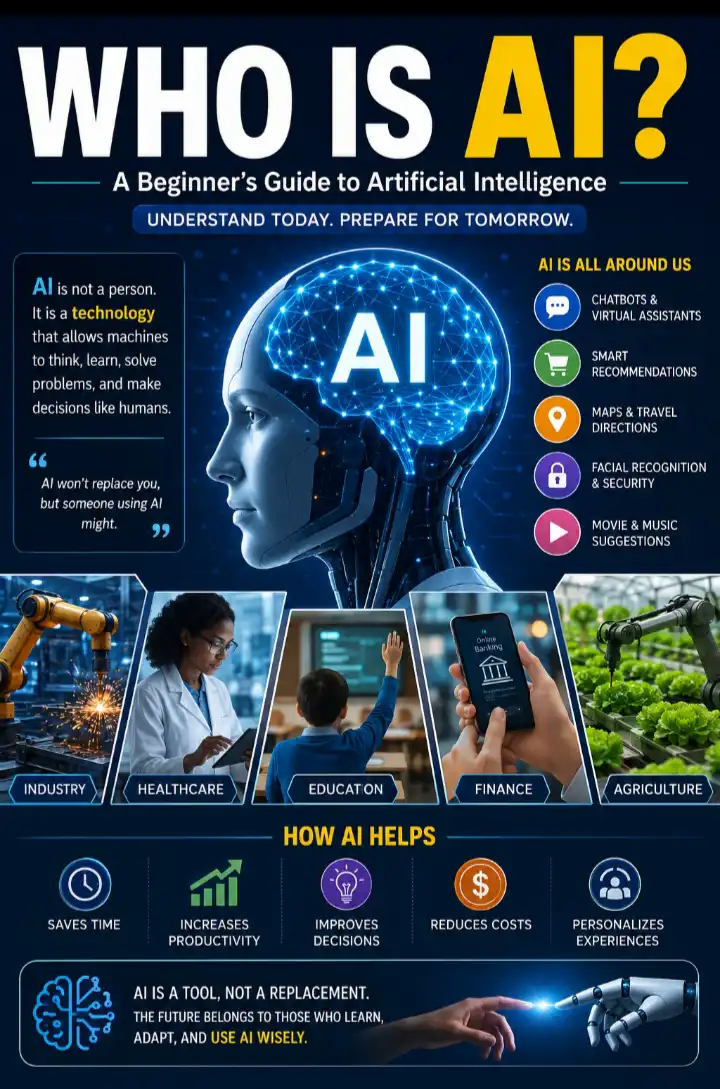
Artificial Intelligence (AI) is not a person, company, or single machine. AI is a branch of computer science that enables computers and software to perform tasks that normally require human intelligence. These tasks include learning, reasoning, understanding language, recognizing images, solving problems, and making predictions based on data.
Today, AI powers many of the technologies people use every day. When you ask a chatbot a question, receive movie recommendations on Netflix, use Google Maps for directions, unlock your phone with facial recognition, or shop online and receive personalized product suggestions, AI is working behind the scenes.
Artificial intelligence is transforming nearly every industry, including healthcare, education, banking, agriculture, manufacturing, transportation, entertainment, and digital marketing. As AI continues to evolve, understanding how it works is becoming an essential skill for students, professionals, entrepreneurs, and everyday internet users.
Also read How to Completely Disable Google AI Overviews in Chrome 2026 Update
1. Who Is This Article For?
This article is written for:
- Complete beginners who want to understand AI.
- Students learning about emerging technology.
- Business owners looking to improve efficiency.
- Freelancers and creators who want to use AI tools.
- Professionals seeking to increase productivity.
- Anyone curious about how AI is changing the world.
No technical background is required.
2. How Would You Explain AI to Someone Who Has Never Heard of It?
Imagine having an assistant that can read thousands of books in seconds, answer questions, write emails, create images, analyze data, and help solve problems. That assistant is powered by artificial intelligence.
AI allows computers to recognize patterns, learn from information, and make decisions without being explicitly programmed for every situation. Instead of replacing human intelligence, AI is designed to assist people by completing repetitive tasks faster and helping them make better decisions.
3. How Has AI Changed the Way People Work?
Artificial intelligence has changed how millions of people work by helping them complete tasks more efficiently.
People now use AI to:
- Write articles and reports.
- Generate marketing ideas.
- Create graphics and videos.
- Translate languages.
- Analyze large amounts of data.
- Write computer code.
- Answer customer questions.
- Automate repetitive business tasks.
Many users report that AI helps them save time, increase productivity, and focus on higher-value work. However, AI-generated content should always be reviewed for accuracy and quality before it is published or relied upon.
4. A Real Example of AI in Action
A small online business wanted to increase website traffic without hiring a large marketing team.
The owner used AI to:
- Brainstorm blog topics.
- Draft article outlines.
- Generate social media captions.
- Improve product descriptions.
- Create promotional images.
- Research customer questions.
By combining AI with human editing and good SEO practices, the business published more content consistently, increased website visitors, and reduced the time spent on routine marketing tasks.
This example illustrates how AI can improve productivity when used thoughtfully alongside human judgment.
5. Which AI Tools Are Most Useful Today?
Some of today’s most popular AI tools include:
- ChatGPT – Writing, brainstorming, coding assistance, and research support.
- Claude – Long-form writing, analysis, and document assistance.
- Google Gemini – AI search, productivity, and information retrieval.
- Microsoft Copilot – AI assistance within Microsoft Office applications.
- Perplexity AI – AI-powered search with cited sources.
- Midjourney – AI image generation.
- Adobe Firefly – Creative image editing and design.
- Runway – AI video creation and editing.
- GitHub Copilot – Coding assistance for developers.
Each tool has different strengths, so choosing the right one depends on your goals.
You like to read about this too. How to Make Money With AI in 2026
6. Common Myths About AI
Many misconceptions surround artificial intelligence.
Some people believe AI knows everything or is always correct. In reality, AI can make mistakes and sometimes generates inaccurate information.
Others believe AI will replace every job. While AI will automate certain tasks, it is also creating new roles and changing existing ones. People who learn to work effectively with AI are likely to have an advantage.
Another myth is that AI can think or feel like humans. Current AI systems do not possess consciousness, emotions, or self-awareness. They generate responses by identifying patterns in data rather than understanding the world in the human sense.
7. Where Should Beginners Start?
If you are new to AI, begin with the basics.
Start by:
- Learning what AI is and how it works.
- Practicing with free AI tools.
- Learning how to write clear prompts.
- Checking AI-generated information against reliable sources.
- Using AI to solve small everyday problems before attempting complex projects.
Developing critical thinking skills alongside AI skills is just as important as learning the tools themselves.
8. Common Mistakes Beginners Make
Many beginners expect AI to produce perfect results immediately.
Common mistakes include:
- Accepting AI responses without verifying them.
- Writing vague prompts.
- Sharing sensitive or confidential information with AI systems.
- Depending on AI instead of developing their own knowledge.
- Ignoring copyright and licensing considerations when using AI-generated content.
The best results come from treating AI as a collaborative assistant rather than an infallible expert.
9. Ethical Concerns Everyone Should Understand
Artificial intelligence offers enormous opportunities, but it also presents challenges.
Important issues include:
- Protecting personal privacy.
- Preventing misinformation.
- Respecting copyright and intellectual property.
- Reducing bias in AI systems.
- Being transparent when AI is used.
- Avoiding overdependence on automated tools.
Responsible AI use requires both technological innovation and human accountability.
10. Final Takeaway
Artificial intelligence is one of the most significant technological developments of the modern era. It is changing how people learn, work, create, communicate, and solve problems.
However, AI is not magic, nor is it a replacement for human creativity, judgment, or ethics. The people who will benefit most from AI are those who understand its capabilities, recognize its limitations, verify its outputs, and use it responsibly.
The future belongs not only to those who use AI, but to those who know how to combine AI with human knowledge, creativity, and critical thinking.
Reader love this What Is Digital Marketing?
For breaking news visit www.saharareporters.com
For Question and answers for important topics visit Question And Answers section of DocuNews Central
