
Breaking news
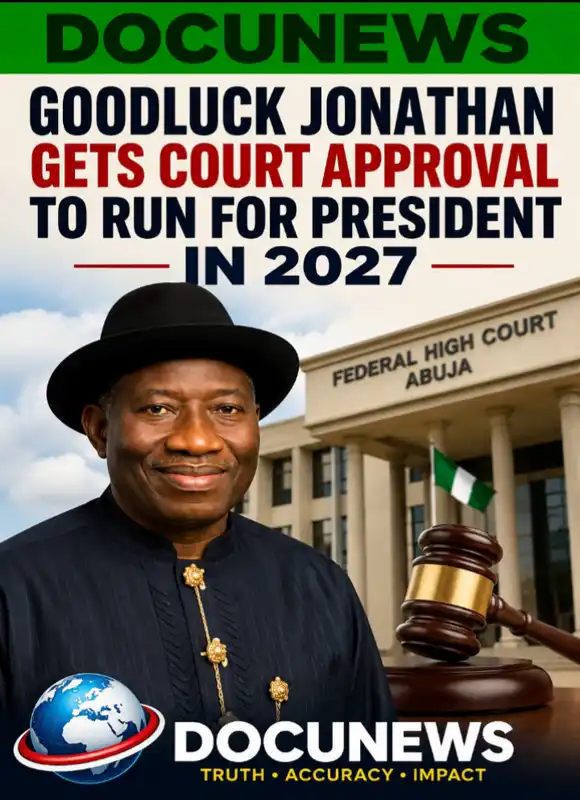
Goodluck Jonathan Gets Court Approval to Run for President in 2027

By Jonadab | Publisher: DocuNews Central 2026-05-26T14:30:00+01:00
A Federal High Court sitting in Abuja has ruled that former Nigerian President Goodluck Jonathan is eligible to contest the 2027 presidential election, ending months of legal uncertainty surrounding his possible political return. The judgment, delivered on Tuesday, provides legal clarity on a constitutional issue that has generated national debate among political leaders, constitutional lawyers, and election observers across Nigeria. Yes Goodluck Jonathan Gets Court Approval to Run for President in 2027
The court ruled that there is no constitutional provision preventing Jonathan from seeking another presidential term. That decision effectively removes the legal obstacle that could have blocked him from entering the 2027 race. While Jonathan has not formally declared his intention to run, the judgment now gives him a clear legal path if he chooses to seek the office again.
The ruling was delivered on 2026-05-26 at the Federal High Court in Abuja, Federal Capital Territory, Nigeria. Justice Peter Lifu presided over the case and dismissed the suit challenging Jonathan’s eligibility, describing the legal action as lacking merit and without sufficient legal basis.
Also read Ex-APC Aide Mustapha Bala Joins Kwankwasiyya Movement
What Happened?
The legal dispute began after an Abuja-based lawyer, Johnmary Jideobi, filed a suit seeking to stop former President Goodluck Jonathan from contesting the 2027 presidential election. The plaintiff argued that Jonathan had already taken the presidential oath twice and therefore should be constitutionally barred from seeking another term under Nigeria’s 1999 Constitution, as amended.
According to court documents, the plaintiff claimed Jonathan’s first oath came in 2010 when he succeeded the late President Umaru Musa Yar’Adua following Yar’Adua’s death in office. His second oath followed after he won the 2011 presidential election and served a full elected term until 2015. Based on that sequence, the plaintiff argued that another term would amount to an unconstitutional extension beyond the allowed presidential limit.
However, Jonathan’s legal team strongly opposed that interpretation. His lawyers argued that previous judicial interpretations had already addressed the matter and that there was no constitutional restriction preventing him from contesting another presidential election. They urged the court to dismiss the case entirely.
Where Did It Happen?
The judgment was delivered at the Federal High Court in Abuja, Nigeria’s capital and the seat of federal judicial authority. Cases involving constitutional interpretation, election law, and federal office eligibility are regularly heard in Abuja because of its central role in national governance and judicial administration.
The courtroom attracted significant political and media attention. Journalists, legal observers, and political stakeholders closely followed the proceedings because the outcome was expected to shape early political calculations ahead of the 2027 election cycle.
Who Is Involved?
Former President Goodluck Ebele Jonathan is the central figure in the case. Jonathan served as Nigeria’s president from 2010 until 2015 and remains one of the country’s most recognized political figures. Since leaving office, he has maintained a visible national and international profile, often participating in peace and democracy missions across Africa.
Justice Peter Lifu delivered the judgment. The plaintiff in the case was Abuja-based lawyer Johnmary Jideobi, who argued that constitutional term limits should prevent Jonathan from contesting again.
The Independent National Electoral Commission, widely known as INEC, and the Attorney-General of the Federation were also listed as defendants because of their constitutional roles in electoral administration and legal oversight.
The Court’s Decision
Justice Peter Lifu ruled that the case lacked merit and should not proceed. In his judgment, he held that the plaintiff failed to establish sufficient legal standing to sustain the action. The court also found that the issue of Jonathan’s eligibility had already been substantially addressed in previous legal rulings.
According to the judgment, there was no fresh constitutional conflict requiring a new judicial restriction against the former president. The court therefore dismissed the suit and affirmed that Goodluck Jonathan remains eligible to contest for the office of President if he decides to do so.
That decision is significant because it removes uncertainty that had lingered around the constitutional interpretation of succession and presidential term limits in Nigeria.
Why This Case Matters
The case raised an important constitutional question: can a president who completed part of another president’s tenure and later won a full elected term seek office again?
That question has remained controversial for years because Nigeria’s constitution limits presidents to two terms, but it also contains provisions dealing with succession after the death or resignation of a sitting president. Jonathan became president after President Yar’Adua died in office in 2010, creating a unique constitutional situation that has repeatedly sparked legal and political debate.
By dismissing the suit, the court has now reinforced an interpretation that Jonathan’s previous service does not automatically disqualify him from future presidential contests.
Political Implications for 2027
The ruling may significantly influence Nigeria’s political landscape as parties begin strategic planning for the 2027 general election. Even though Jonathan has not officially announced his candidacy, his name has repeatedly appeared in political discussions, especially within opposition circles seeking a strong national figure.
Political analysts say the court’s ruling may encourage renewed political consultations among parties and influential stakeholders. If Jonathan decides to run, his entry could alter alliance negotiations, voter calculations, and party strategies nationwide.
According to DocuNews Central, several political observers believe the ruling could reshape early presidential positioning across multiple political parties.
Reaction from Legal Experts
Constitutional lawyers have described the ruling as important because it offers judicial clarity on a long-debated issue. Some legal experts noted that the judgment helps settle confusion over how presidential succession should be interpreted under Nigerian law.
One senior legal analyst in Abuja described the decision as “a reaffirmation of constitutional continuity,” noting that courts are expected to provide certainty in politically sensitive matters such as presidential eligibility.
Others said the ruling strengthens confidence in judicial interpretation ahead of future electoral contests.
Jonathan Has Not Declared
Despite intense public discussion, former President Goodluck Jonathan has not officially declared interest in contesting the 2027 election. No formal campaign announcement has been made, and his political camp has remained publicly cautious.
However, his name has repeatedly surfaced in political calculations because of his national profile, previous leadership experience, and perceived electoral appeal across multiple regions.
The court ruling therefore clears only the legal pathway. The political decision remains entirely his.
What Happens Next?
If Jonathan decides to contest, he must still secure nomination from a registered political party and meet all electoral requirements set by INEC. The ruling does not make him a candidate automatically. It simply confirms that the law does not stop him from seeking office.
That means the next phase, if it comes, will be political rather than judicial. Attention will now shift toward whether Jonathan himself signals any intention to run.
How This Report Was Verified
This report was prepared using verified court reporting and cross-checked national news coverage from multiple Nigerian media organizations that covered proceedings at the Federal High Court in Abuja. Details including the court venue, judge, legal arguments, plaintiff identity, and ruling were reviewed from independent reports to ensure factual accuracy.
Primary reporting sources included Vanguard Nigeria, Politics Nigeria, and other Abuja court correspondents who covered the proceedings directly.