
Security updates Nigeria
Kaduna Attack: Why Bandits Are Winning the War

By Jonadab | April 4, 2026 | DocuNews Central
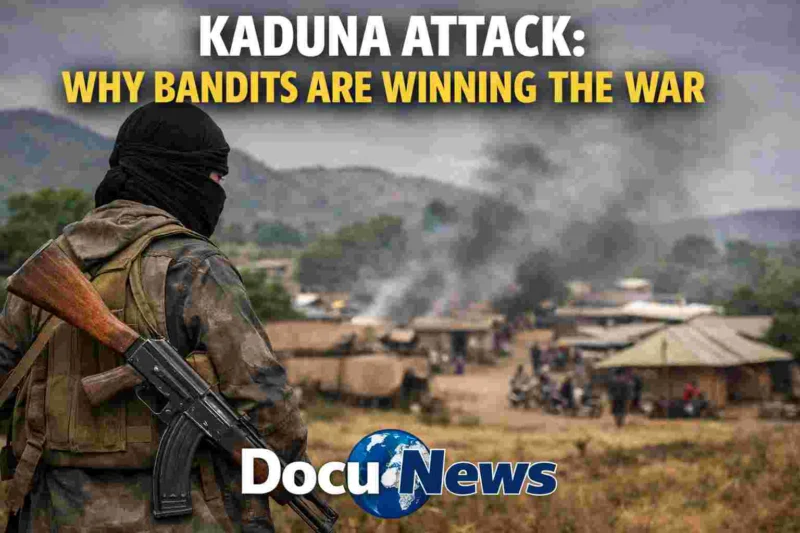
Bandit attacks have continued to rise across Kaduna State despite repeated military operations. Communities have been targeted, while residents have been displaced in growing numbers. Security agencies have intensified patrols, yet attacks persist in several local government areas.
In recent months, coordinated assaults have been reported on villages, highways, and remote settlements. As a result, casualties have increased and economic activities have been disrupted. Although troops have been deployed, the threat has not been fully contained.
Recent Attack Highlights Security Concerns
A fresh attack has once again exposed gaps in the security architecture. Armed bandits reportedly stormed communities, leading to deaths and abductions. While security forces responded, the attackers had already inflicted significant damage.
Moreover, residents described the incident as swift and organized. Witness accounts suggested that the attackers operated with clear coordination. Consequently, fear has spread among affected communities.
Date and Location of the Incident
According to DocuNews Central, the latest attack was reported on April 2, 2026, in parts of southern Kaduna. Several rural settlements were affected during the overnight assault. Security operatives were deployed shortly after the incident was reported.
Although reinforcement arrived, the attackers had already retreated into surrounding forests. Therefore, the operation shifted toward pursuit and recovery efforts. Local authorities confirmed casualties and ongoing investigations.
Also read Gunmen Kidnap 7 Family Members, 3 Others in Southern Kaduna
Why Bandits Continue to Gain Ground
Multiple factors have contributed to the persistence of banditry in Kaduna. First, vast forest areas have provided safe havens for armed groups. These locations have remained difficult to monitor despite aerial surveillance.
Second, logistical challenges have limited rapid response capabilities. In many cases, attacks occur in remote areas where access roads are poor. As a result, security forces often arrive after significant damage has been done.
Additionally, intelligence gaps have been identified as a major concern. Although efforts have been made to gather local information, coordination remains inconsistent. Consequently, bandits have exploited these weaknesses.
Impact on Local Communities
Communities across Kaduna have experienced severe humanitarian impacts. Many residents have been displaced and forced to seek shelter in neighboring towns. Furthermore, farming activities have been disrupted, affecting food supply.
Schools and markets have also been affected by the ongoing insecurity. In some areas, educational activities have been suspended due to safety concerns. As a result, children have been denied access to learning.
Healthcare services have equally suffered disruptions. Clinics in remote areas have struggled to operate under threat conditions. Therefore, access to medical care has been reduced.
Security Operations and Military Response
Security forces have continued to conduct operations across Kaduna State. Troops have been deployed to hotspots, while patrols have been intensified. In several cases, bandits have been neutralized during engagements.
However, despite these efforts, attacks have not been completely stopped. Bandits have adapted their tactics and shifted locations. Consequently, the conflict has remained fluid and unpredictable.
Air surveillance has also been utilized to track movements. Nevertheless, dense forest cover has limited visibility in some regions. Therefore, ground operations remain essential.
Role of Intelligence and Community Cooperation
Effective intelligence gathering has been identified as a key requirement. Security agencies have encouraged communities to share timely information. However, fear of retaliation has discouraged cooperation in some areas.
Trust between residents and authorities has also been a challenge. In certain cases, communities have expressed concerns about delayed responses. As a result, information flow has been affected.
Efforts are being made to strengthen collaboration. Community policing initiatives have been introduced in some locations. Therefore, gradual improvements are being observed.
Economic Drivers Behind Banditry
Economic hardship has been linked to the rise in banditry. Limited employment opportunities have pushed some individuals toward criminal activities. Additionally, illegal mining and cattle rustling have fueled the crisis.
Ransom payments have also sustained bandit operations. Kidnappings have become a major source of funding. Consequently, criminal networks have expanded.
Border security challenges have further complicated the situation. Movement of arms and fighters across regions has been reported. Therefore, a broader security approach has been recommended.
Government Policies and Challenges
The government has introduced several measures to address insecurity. Military deployments have been increased, while negotiations have been attempted in the past. However, results have been mixed.
Some policies have faced implementation challenges. Funding constraints and logistical issues have affected operations. As a result, long-term solutions have remained limited.
Legal frameworks have also been reviewed to strengthen enforcement. Arrests have been made, but prosecution processes have sometimes been slow. Therefore, deterrence has not been fully achieved.
Regional Security Implications
The situation in Kaduna has affected neighboring states. Bandit groups have moved across borders, spreading insecurity. Consequently, a regional security approach has become necessary.
Joint operations have been conducted in collaboration with other states. Intelligence sharing has been improved to track movements. However, coordination challenges still exist.
Cross-border crime has also been linked to the crisis. Arms trafficking routes have been identified in some areas. Therefore, enhanced surveillance has been recommended.
Steps Toward Lasting Solutions
Security experts have emphasized the need for comprehensive strategies. Military action alone has been considered insufficient. Therefore, economic and social interventions have been proposed.
Investment in rural development has been suggested as a long-term solution. Job creation and infrastructure improvements could reduce vulnerability. As a result, recruitment into criminal groups may decline.
Education and awareness programs have also been recommended. Communities could be empowered to resist criminal influence. Consequently, resilience could be strengthened.
Conclusion
Bandit attacks in Kaduna have remained a significant challenge despite ongoing efforts. While security forces have recorded successes, gaps continue to be exploited. Therefore, a combination of military, economic, and social strategies has been required.
As operations continue, attention has been focused on addressing root causes. Improved coordination and community engagement have been identified as priorities. Consequently, long-term stability may depend on sustained and integrated efforts.
For Security Updates in Nigeria visit Security updates Nigeria
Related Resources
Nigerian Defence Headquarters
Nigeria Police Force
Humanitarian Updates and Reports