
Breaking news
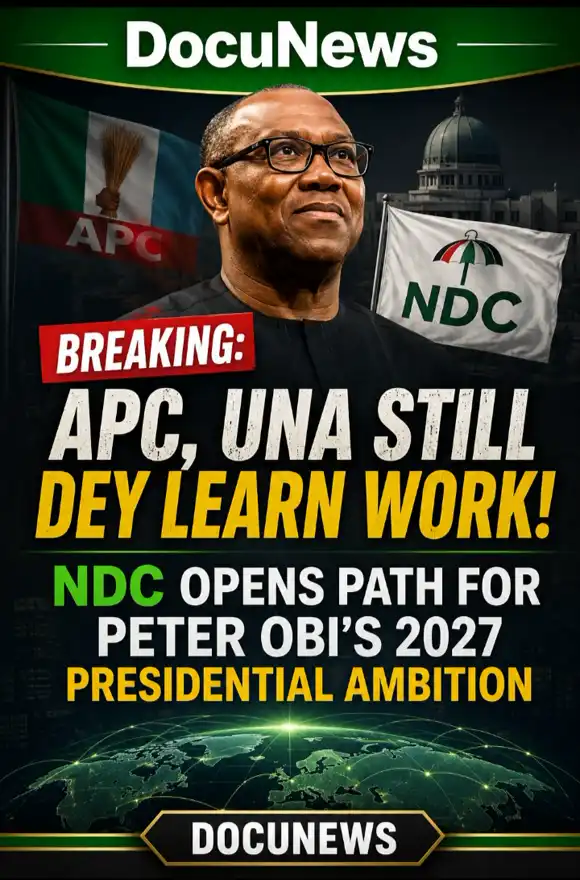
NDC Opens Path for Peter Obi’s 2027 Presidential Ambition

By Jonadab | Publisher: DocuNews Central
May 27, 2026
The Nigeria Democratic Congress (NDC) has formally opened the path for former Anambra State governor Peter Obi to pursue his 2027 presidential ambition after the party zoned its presidential ticket to Southern Nigeria. The development followed resolutions adopted during the party’s national convention held in Abuja.
According to DocuNews Central, the decision has already changed political calculations ahead of the 2027 general election. Political observers believe the move strengthens Obi’s position within the opposition coalition at a time when several politicians continue to realign across party lines.
On May 9, 2026, in Abuja, delegates at the NDC convention voted in support of a zoning arrangement that reserves the party’s presidential ticket for Southern Nigeria for a single four-year term. The decision was announced by party leaders after deliberations involving members of the National Executive Committee and convention delegates.
What Happened at the NDC Convention?
The convention became one of the most closely watched political gatherings in Nigeria this year. Delegates approved a motion supporting the zoning of the presidential ticket to the South. Party officials said the arrangement was designed to maintain regional balance and strengthen unity within the coalition.
According to reports monitored by DocuNews Central, the motion was moved by Afam Ogene, a federal lawmaker representing Ogbaru Federal Constituency in Anambra State. Delegates later adopted the proposal through a voice vote during the convention session in Abuja.
The resolution further stated that after the proposed single four-year term, the presidential ticket would return to Northern Nigeria in 2031. Party leaders described the formula as part of a broader power-sharing arrangement intended to reduce internal disputes before the next election cycle.
The announcement immediately triggered reactions across the political space. Supporters of Peter Obi described the development as a strategic opening for the former Labour Party presidential candidate. Meanwhile, rival political camps began reassessing possible coalition strategies ahead of the 2027 contest.
Also read APC Betrayed Me — Ned Nwoko Speaks on Broken Ticket Promise.
How Peter Obi Benefited From the Decision
Peter Obi remains one of the most influential opposition figures in Nigeria after his performance in the 2023 presidential election. Since then, conversations around coalition politics have continued to dominate national discussions. The NDC zoning arrangement has now increased speculation that Obi could emerge as the party’s leading presidential candidate.
According to DocuNews Central, Obi recently completed screening processes within the party after purchasing the NDC presidential nomination form. Reports also indicated that he emerged as the sole aspirant who obtained the presidential expression of interest form before the deadline expired.
The development has strengthened his political standing within the party structure. Several political analysts now believe the opposition coalition may rally behind Obi in an attempt to present a united challenge against the ruling All Progressives Congress ahead of the next election.
Although Obi has not officially declared victory within the party, he reportedly told journalists after his screening that the process remained open and democratic. He also commended the screening committee for conducting a transparent exercise.
Where Did the Political Realignment Begin?
The political realignment gained momentum after opposition consultations intensified earlier in 2026. Several meetings involving political stakeholders reportedly focused on coalition building and possible mergers ahead of the 2027 general election.
According to multiple political reports reviewed by DocuNews Central, Obi and former Kano State governor Rabiu Kwankwaso later aligned with the Nigeria Democratic Congress after leaving previous political platforms. The movement generated nationwide debate because both politicians retain large support bases across different regions.
Political observers noted that the coalition discussions became more serious after internal disputes affected several opposition parties. As a result, some politicians began searching for a fresh political structure capable of competing nationally against the APC.
The emergence of the NDC as a coalition platform has therefore changed the direction of opposition politics. The party has continued attracting attention because of its growing list of influential defectors and political stakeholders.
Reaction From Party Leaders
NDC National Chairman Moses Cleopas defended the zoning arrangement during the convention. He explained that the decision reflected the party’s commitment to fairness and political inclusion across Nigeria’s regions.
According to DocuNews Central, party leaders insisted that the arrangement would reduce future leadership disputes while encouraging broader participation from different geopolitical zones. They also maintained that the zoning structure followed consultations among stakeholders within the coalition.
Rabiu Kwankwaso also reportedly backed the arrangement during interactions with delegates at the convention venue. He described the decision as consistent with the principles of equity and political understanding among coalition members.
Several delegates applauded after the announcement. Supporters waved party flags while chanting slogans in support of opposition unity ahead of the 2027 election cycle.
APC and Opposition Politics Ahead of 2027
The ruling All Progressives Congress remains Nigeria’s dominant political party at the federal level. However, opposition figures continue searching for a coalition capable of presenting a stronger challenge in 2027.
According to DocuNews Central, conversations around coalition politics have intensified because opposition parties performed below expectations in previous elections due to internal divisions and fragmented votes. Political strategists now believe a united opposition ticket could reshape the political landscape if major stakeholders remain together.
The headline phrase, “APC, Una Still Dey Learn Work,” reflects growing political confidence among some opposition supporters following the NDC decision. Nevertheless, analysts caution that coalition management may become difficult if disagreements emerge during party primaries or negotiations over key positions.
Several APC leaders have yet to issue formal responses regarding the NDC zoning arrangement. However, political observers expect stronger reactions as campaign activities gradually approach ahead of the next general election season.
Who Is Involved in the Emerging Coalition?
The emerging coalition currently includes several notable politicians and political stakeholders from different parts of the country. Peter Obi remains one of the central figures because of his strong support base among young voters and urban populations.
Rabiu Kwankwaso also continues to attract attention because of his political structure in Northern Nigeria. Analysts believe his influence may become important if coalition leaders attempt to build wider national acceptance before 2027.
Former governors, lawmakers, party officials, and regional stakeholders have reportedly participated in consultations linked to the coalition movement. Although some discussions remain private, political insiders believe negotiations are still ongoing regarding future leadership arrangements.
According to DocuNews Central, several stakeholders within the opposition continue emphasizing unity, electoral reforms, and internal democracy as major priorities before the next election cycle officially begins.
Authority Comments on the Development
Political analyst Dr. Hassan Bello described the NDC zoning decision as a strategic political calculation intended to stabilize the opposition coalition before internal rivalries escalate. He noted that zoning arrangements often influence political negotiations in Nigeria because parties attempt to maintain regional balance.
Meanwhile, constitutional lawyer Amina Yusuf stated during a television interview monitored by DocuNews Central that the success of the coalition would depend largely on discipline among party leaders. According to her, coalition politics in Nigeria often struggles when personal ambitions begin competing with collective agreements.
Election observers also warned that opposition unity may remain temporary unless clear agreements are reached regarding campaign structures, funding, and regional representation. Nevertheless, many analysts agree that the NDC decision has already reshaped early conversations surrounding the 2027 election.
Several civil society groups also reacted to the development by calling for issue-based campaigns ahead of the election period. They urged political parties to focus on governance, economic recovery, security, and youth employment rather than divisive rhetoric.
Why the Decision Matters Politically
The NDC resolution matters because presidential zoning remains one of the most influential political traditions in Nigeria. Although zoning is not directly contained in the constitution, major political parties frequently use it to manage regional interests and maintain internal stability.
According to DocuNews Central, the decision also carries symbolic importance because it signals that opposition stakeholders may finally be willing to compromise in pursuit of a broader coalition strategy. Political analysts believe this may improve coordination among opposition parties ahead of future campaigns.
The arrangement further strengthens discussions around a possible single-term presidency. Some coalition stakeholders reportedly believe a one-term agreement could encourage wider northern support while preserving regional balance after President Bola Tinubu’s tenure.
However, critics have argued that zoning arrangements alone cannot guarantee electoral success. They insist that voters will still focus on economic conditions, national security, inflation, electricity supply, and unemployment during the campaign period.
Growing Public Attention Across Nigeria
Public discussions surrounding the NDC decision have continued expanding across social media platforms, television stations, and political gatherings. Supporters of the coalition argue that the emerging alliance may introduce stronger competition into the political environment ahead of 2027.
At the same time, critics remain skeptical about the durability of the coalition. Some observers recall previous opposition alliances that later collapsed because of disagreements involving ticket allocation and party leadership.
According to DocuNews Central, the coming months may become critical for the coalition because party leaders must now demonstrate organizational strength beyond convention announcements. Analysts believe voters will closely monitor how coalition members manage internal disagreements moving forward.
The Independent National Electoral Commission is also expected to monitor political activities as parties begin preparing for future primaries and campaign schedules in line with electoral regulations.
What Happens Next?
The next major phase involves party primaries, coalition negotiations, and broader political consultations. Peter Obi’s position within the NDC will likely become clearer after additional internal processes are completed.
According to DocuNews Central, party leaders are expected to continue consultations with stakeholders across Nigeria as preparations intensify ahead of the next general election. Discussions surrounding campaign strategy, vice-presidential considerations, and regional alliances may also become more visible in the coming months.
Political observers believe the ruling APC will also strengthen preparations as opposition coalitions continue expanding. Analysts therefore expect the political atmosphere to remain highly competitive throughout the pre-election period.
For now, the NDC convention decision has already altered early political calculations across the country. Whether the coalition succeeds or struggles later will depend largely on how party leaders manage unity, negotiations, and voter expectations before 2027.
Sources used for this report: