
Security updates Nigeria
8 Dead, 23 Injured as ISWAP Attacks Borno Base.

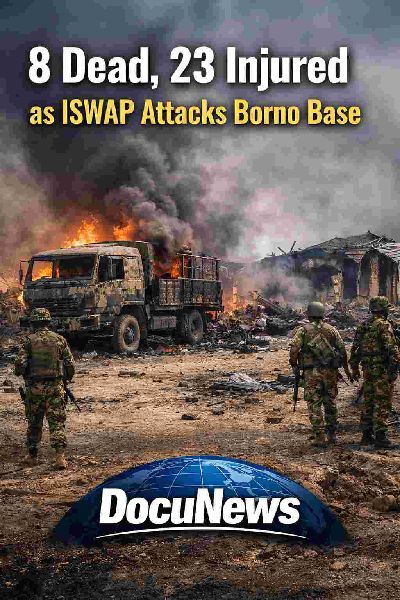
Bandits has attack Soldiers again in Borno. The attack results in 8 Dead, 23 Injured as ISWAP Attacks Borno Base. This has once again shaken Nigeria’s northeast, the armed fighters stormed a military formation, killed eight soldiers, injured twenty-three others, burned parts of the facility, and seized weapons. The coordinated assault shows a troubling escalation in insurgent operations. More importantly, it raises urgent questions about security architecture in a region that has faced violent extremism for more than a decade. But the disturbing question is, how did they succeed.
According to DocuNews Central, the deadly incident occurred in Cross Kauwa, a strategic community in Borno State, Nigeria, near the Lake Chad basin. Security sources confirmed that heavily armed fighters linked to the Islamic State West Africa Province, widely known as ISWAP, invaded the base under the cover of darkness. The attackers engaged troops in a prolonged firefight before setting parts of the base ablaze and retreating with looted arms.
Eyewitness who spoke to DocuNews Central revealed that the insurgents arrived in multiple vehicles and motorcycles, fired rocket-propelled grenades, and deployed sophisticated rifles. Although soldiers resisted strongly, the attackers gained ground due to surprise and numerical advantage. Eventually, the fighters destroyed sections of the facility and withdrew through routes that connect to remote settlements.
A Calculated Assault on Cross Kauwa
Cross Kauwa holds strategic importance because it connects rural communities to waterways leading toward Lake Chad. Insurgents often exploit the marshy terrain around the lake to move equipment, regroup, and avoid aerial detection. Therefore, any attack in this corridor carries serious security implications.
Reports indicate that the insurgents planned the assault carefully. First, they monitored troop movement patterns. Next, they struck when visibility dropped. Furthermore, they blocked possible reinforcement routes. As a result, soldiers at the base faced operational disadvantages that limited rapid response.
Security analysts argue that the attackers pursued multiple objectives. They aimed to weaken morale. They wanted to seize weapons. Additionally, they intended to send a symbolic message of strength. Consequently, the raid served tactical and propaganda purposes.
Read also Gunmen Kill Agamọ Monarch in Failed Kidnap Plot.
Rising Insurgency in the Northeast
Over the past year, insurgent activity in the northeast has intensified. Although security forces recorded earlier gains, recent months have witnessed renewed coordinated assaults. Notably, fighters now target isolated formations and supply routes rather than crowded civilian centers.
The insurgency traces its roots to Boko Haram, a militant movement that later fractured. One faction aligned with the Islamic State network and rebranded as ISWAP. Since then, ISWAP has adopted more structured strategies, enforced discipline within its ranks, and focused heavily on military infrastructure.
Meanwhile, communities across Borno continue to endure anxiety. Farmers abandon distant fields. Traders restrict movement. Parents worry about safety. As violence spreads, everyday life becomes increasingly fragile.
Heavy Casualties and Human Cost
The loss of eight soldiers represents a painful blow for families and fellow servicemen. Each fallen officer leaves behind loved ones who must confront sudden grief. In addition, twenty-three injured personnel now receive medical treatment in military facilities. Doctors and nurses continue to provide urgent care while commanders monitor recovery progress.
Beyond the immediate casualties, the attack triggers emotional and psychological distress. Survivors often struggle with trauma. Civilians near the base witnessed explosions and intense gunfire that disrupted the night. Consequently, fear and uncertainty have returned to the surrounding communities.
However, military authorities have pledged swift action. They launched search operations to track fleeing attackers. They reinforced nearby formations to prevent additional assaults. Furthermore, they reassured residents that security efforts would intensify.
You may have missed this Boko Haram Used Call to Prayer to Gather Victims for Deadly Attack
Strategic Implications for the Nigerian Army
The Nigerian Army plays a central role in counterinsurgency efforts across the northeast. Therefore, any successful raid against its installations demands strategic reassessment. Commanders must review defensive layouts, upgrade intelligence systems, and strengthen rapid response capabilities.
Insurgents often rely on mobility. They strike quickly and retreat through hidden routes. Thus, security forces require expanded surveillance coverage, improved aerial reconnaissance, and stronger collaboration with local communities for intelligence gathering.
Regional cooperation also remains essential. The Multinational Joint Task Force coordinates joint operations among Nigeria, Chad, Niger, and Cameroon. Through intelligence sharing and joint patrols, the coalition aims to disrupt cross-border insurgent activities.
Economic and Social Consequences
Violence in Borno disrupts commerce and agriculture. Traders avoid risky highways. Transport costs increase. Food prices rise in urban markets. As a result, inflationary pressure affects vulnerable households.
Furthermore, prolonged instability discourages private investment. Infrastructure projects slow down. Employment opportunities shrink. Therefore, insecurity continues to hinder economic recovery and regional development.
Humanitarian agencies also face mounting pressure. Displaced families seek refuge in safer towns. Camps become overcrowded. Aid workers struggle to provide adequate shelter, water, and healthcare support.
National and International Response
The attack has intensified national conversations about security reform. Citizens demand stronger protection for frontline troops and more visible progress against insurgency. Policymakers may respond by reassessing defense spending, procurement strategies, and troop deployment models.
International observers continue to monitor developments. Organizations such as the United Nations Office for West Africa highlight the need for coordinated regional strategies. More information about regional security efforts appears on the official UNOWAS website: https://unowas.unmissions.org/.
Similarly, the Economic Community of West African States emphasizes collaborative security frameworks. Details on regional cooperation initiatives can be found on the ECOWAS website: https://www.ecowas.int/.
For deeper background on ISWAP’s evolution and regional impact, readers may consult analysis published by the Council on Foreign Relations: https://www.cfr.org/.
DocuNews Central Opinion
At DocuNews Central, we believe the tragic headline, 8 Dead, 23 Injured as ISWAP Attacks Borno Base, demands sober reflection and decisive action. First, authorities must honor fallen soldiers through concrete reforms that strengthen operational readiness. Second, security leadership must prioritize intelligence coordination and rapid deployment systems. Third, policymakers should address socioeconomic drivers that fuel extremist recruitment.
Unity remains essential. Communities, security agencies, and political leaders must collaborate consistently. Transparent communication can build trust. Sustainable peace requires more than military operations. It demands inclusive governance, economic opportunity, and credible community engagement.
Conclusion
The attack that left eight soldiers dead and twenty-three injured underscores persistent security challenges in Nigeria’s northeast. Although troops resisted bravely, insurgents exploited tactical gaps. Consequently, the incident highlights vulnerabilities that require urgent review.
Nevertheless, resilience defines the region. Security forces continue operations. Communities refuse to surrender hope. Policymakers explore strategic reforms. Through sustained effort, regional cooperation, and strengthened intelligence systems, Nigeria can confront insurgency more effectively and restore lasting stability in Borno and beyond.
For Security Updates In Nigeria Visit Security updates Nigeria