
Israeli-Iran-U.S War
Who Killed Iranian Leader Ayatollah Ali Khamenei? Latest Update

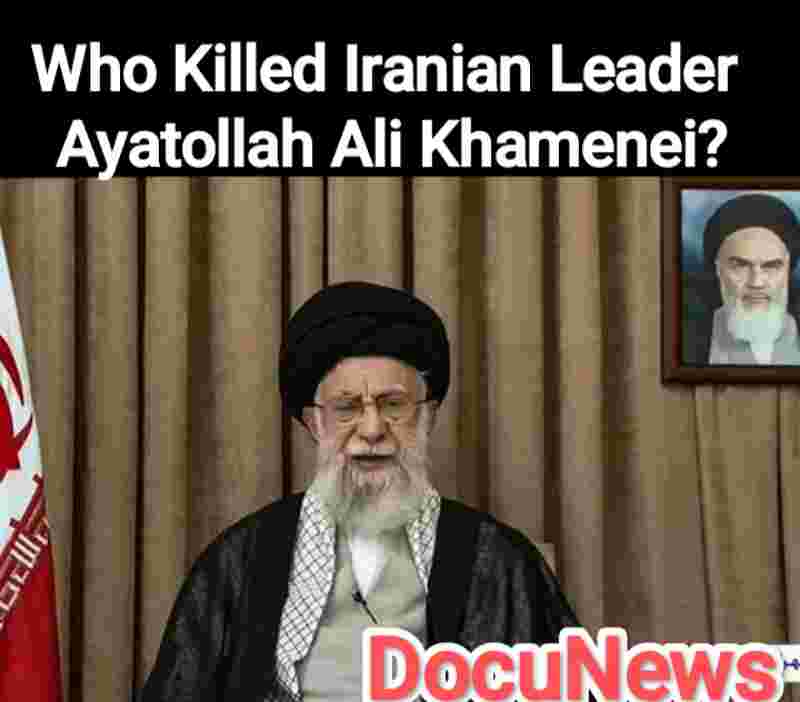
Who killed Iranian leader Ayatollah Ali Khamenei? That question now dominates global headlines after Tehran officially confirmed on March 1, 2026, that Ayatollah Ali Khamenei is dead following an Israeli strike on the Iranian capital. The phrase “Who killed Iranian leader Ayatollah Ali Khamenei” has surged across search engines as governments, analysts, and citizens seek clarity about what truly happened inside Tehran. Unlike earlier speculation, this development no longer rests on rumor. Iranian state-controlled media channels formally announced his death and declared a period of national mourning, thereby transforming a tense geopolitical situation into a historic turning point in Middle Eastern politics.
According to Docunews Central, the official announcement came from Tehran, Iran, where authorities confirmed that the Supreme Leader succumbed to injuries sustained during explosions that followed Israel’s acknowledged military operation inside the capital. Israeli officials had earlier confirmed that their forces struck what they described as high-value strategic command infrastructure in Tehran. Shortly after Iran’s declaration, Israeli defense sources did not deny that facilities linked to the Supreme Leader were located within the targeted zone. As a result, two narratives merged: Israel acknowledged the strike area, and Iran confirmed that its highest authority died from injuries connected to that operation.
This convergence of confirmation has shifted the debate from speculation to responsibility. Iran directly blames Israel for carrying out what it describes as a deliberate leadership assassination. At the same time, Israeli officials maintain that the strike aimed at dismantling command structures rather than specifically targeting an individual. Consequently, global observers now analyze whether the operation represented a calculated decapitation strategy or a high-risk military strike whose outcome reshaped the political landscape of the region. From the side of Iranian, it was a calculated strike to eliminate their supreme leader.
The Official Death Announcement from Tehran
From the report reaching Docunews Central, On March 1, 2026, Iranian state television interrupted regular programming to broadcast Quranic recitations and an official statement confirming the death of the Supreme Leader. Senior clerics appeared on national television to declare a nationwide mourning period, and government institutions lowered flags to half-staff across Tehran. Authorities stated that Ayatollah Ali Khamenei suffered fatal injuries during the Israeli strike and died shortly afterward despite emergency medical efforts. The tone of the announcement emphasized both grief and defiance, framing the event as a martyrdom resulting from foreign aggression.
Government spokespeople described the strike as a calculated assault on a secured compound frequently used for strategic consultations. According to their statement, precision-guided munitions struck within a highly restricted zone, thereby reinforcing claims that the attack did not occur randomly. Iranian officials strongly condemned Israel and accused it of intentionally eliminating the country’s highest-ranking political and religious authority. They also alleged intelligence cooperation from Western allies, although they did not publicly release technical evidence to support that accusation. the question is, Israeli’s government are they denying it?
The confirmation ended days of uncertainty. International media outlets quickly updated their reports to reflect Tehran’s declaration. Financial markets reacted immediately, and diplomatic channels intensified communication. From that moment forward, the discussion centered on accountability and consequences rather than survival speculation.
Read also Iranian Leader Ayatollah Ali Khamenei Has Been Confirmed Dead – Full Details
Israel’s Position on the Tehran Strike
Israel publicly acknowledged that it conducted a strike inside Tehran, describing the operation as necessary to disrupt Iranian military coordination and strategic command capabilities. Read here (Israel Confirms Strike on Iran — Smoke and Explosions Visible in Tehran. Latest Updates ) Defense officials stated that the mission targeted infrastructure connected to regional destabilization activities. However, Israeli authorities stopped short of explicitly stating that the objective involved eliminating the Supreme Leader. Instead, they emphasized that the strike focused on strategic assets considered legitimate military targets.
Shortly after Iran confirmed Khamenei’s death, Israeli security sources did not deny that the targeted zone included facilities associated with senior leadership. Nevertheless, official statements avoided direct language such as “assassination” or “leadership elimination.” This careful phrasing has fueled international debate. Analysts argue that striking within proximity to the Supreme Leader’s compound indicates access to high-level intelligence and suggests that decision-makers understood the risks involved. At the same time, Israeli officials maintain that the objective centered on operational capability rather than personal targeting.
The distinction between targeting infrastructure and targeting leadership remains central to the unfolding geopolitical narrative. Regardless of stated intent, the outcome has fundamentally altered the balance of power in the region.
Did Israel Directly Target the Supreme Leader?
The question now dominating diplomatic conversations is whether Israel deliberately executed a decapitation strategy. Iran firmly asserts that the strike constituted a direct assassination designed to destabilize its political structure. Israeli officials acknowledge the strike’s location but frame it as a broader strategic operation. Therefore, both interpretations coexist in the international arena, and each carries significant consequences for how history will record this event.
Military doctrine recognizes decapitation strategies as efforts to dismantle adversarial command hierarchies by removing central authority figures. If such a strategy guided the Tehran strike, then the elimination of Ayatollah Ali Khamenei would represent one of the most consequential leadership removals in modern Middle Eastern history. Conversely, if leadership loss occurred as a secondary outcome of infrastructure targeting, the legal and diplomatic framing would differ, although the geopolitical impact would remain severe.
Because Israel has not explicitly declared an intention to eliminate Khamenei, and because Iran has not released independent forensic evidence, the debate over intent continues. However, the chronological sequence remains clear: Israel confirmed striking Tehran, and Iran confirmed that the Supreme Leader died from injuries sustained during that strike.
Immediate Political Impact Inside Iran
Following the announcement, Iranian authorities initiated constitutional procedures for leadership succession. The Assembly of Experts convened emergency sessions to begin discussions regarding the appointment of a new Supreme Leader. Political factions within the country now face a delicate balancing act as they navigate the transition while projecting unity. Historically, moments of leadership change during crisis can either consolidate authority or intensify internal competition, and observers closely monitor signals from influential clerical and Revolutionary Guard figures.
Public reaction inside Iran combines grief, anger, and uncertainty. State media portrays the event as martyrdom and emphasizes resilience. At the same time, security presence across Tehran has increased significantly to prevent unrest or foreign interference. The leadership vacuum, even if temporary, introduces strategic vulnerability, and policymakers must act quickly to maintain institutional stability.
The political transition will likely influence Iran’s regional posture. Hardline elements may advocate for decisive retaliation, while pragmatic voices may urge calculated response to avoid broader conflict. The direction chosen in the coming weeks will shape the region’s trajectory.
Regional and Global Security Implications
The confirmed death of Iran’s Supreme Leader has triggered heightened alert levels across the Middle East. Israel has strengthened defensive readiness, anticipating potential retaliation. Allied groups aligned with Iran may respond through asymmetric operations, cyber campaigns, or missile deployments. Consequently, neighboring states have reinforced security protocols and increased intelligence coordination.
Global markets have responded with volatility, particularly in the energy sector. Oil prices surged sharply after the announcement, reflecting fears of supply disruption in a region critical to global energy distribution. Shipping activity near strategic maritime corridors faces increased scrutiny, and insurers reassess risk exposure in light of escalating tensions.
Diplomatically, major powers have called for restraint while seeking clarity. Emergency consultations at the United Nations highlight the seriousness of the situation. Governments recognize that escalation could destabilize not only regional security but also international economic stability.
Media Responsibility and Narrative Control
The initial hours following the strike witnessed rapid dissemination of unverified claims. However, Tehran’s official March 1 confirmation ended uncertainty regarding survival. The focus has since shifted toward motive, responsibility, and long-term implications. Responsible reporting requires careful differentiation between confirmed facts and political framing. Iran unequivocally attributes responsibility to Israel, while Israel confirms the strike but limits comment on specific targeting intentions.
Readers seeking verified updates should rely on established international outlets for ongoing coverage, including BBC, Reuters, Al Jazeera, and CNN. Continued regional analysis and balanced reporting are also available at DocuNews Central, where developments are tracked with attention to verification and context.
DocuNews Central Opinion
From our editorial perspective at DocuNews Central, the confirmed death of Ayatollah Ali Khamenei marks a defining moment in contemporary geopolitics. Israel acknowledged striking Tehran, and Iran confirmed that the Supreme Leader died from injuries sustained during that operation. While Israel frames the mission as strategic infrastructure targeting, Iran characterizes it as deliberate assassination. Both narratives shape international perception, yet the factual sequence remains undisputed.
This event introduces profound uncertainty. Leadership transitions under crisis conditions often intensify strategic recalculations. Therefore, restraint, verification, and diplomatic engagement must guide global decision-making. Escalation would deepen instability across a region already burdened by longstanding conflict.
Conclusion
Who killed Iranian leader Ayatollah Ali Khamenei? Tehran officially declares that Israel’s strike on the capital caused his death. Israel confirms that it struck infrastructure within Tehran and does not deny that leadership-linked facilities were included in the operational area. The overlap between these confirmations connects the military action directly to the Supreme Leader’s fatal injuries.
History will determine whether this moment is remembered primarily as targeted assassination or as a strategic strike that resulted in leadership elimination. For now, the geopolitical landscape has shifted dramatically. Iran faces a leadership transition, Israel braces for potential retaliation, and the international community urges restraint. The Middle East stands at a crossroads, and the decisions taken in the coming days will shape regional stability for years to come.
Also visit here for updates on this ongoing war Israeli-Iran War