
Israeli-Iran-U.S War
Iran Accuses US and Israel of Civilian Strike; Rubio Denied It.

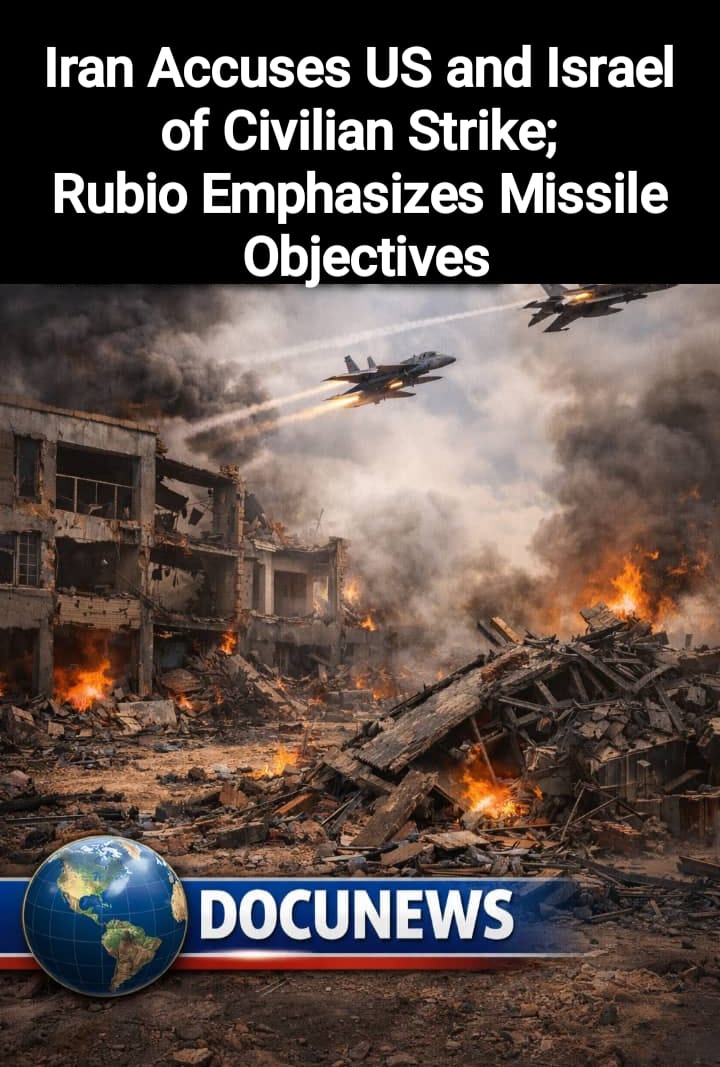
Iran Accuses US and Israel of Civilian Strike; Rubio Emphasizes Missile Objectives. According to DocuNews Central, this has become talk of the town in the Middle East. Iranian officials claim that a recent US-Israeli strike hit civilian infrastructure, causing significant casualties. Meanwhile, US Secretary of State Marco Rubio insists that American military actions focus strictly on missile manufacturing sites and launch facilities, not schools or residential areas. Now the Pentagon investigation moves forward, international observers are closely monitoring developments. Let’s watch closely too to see the outcome of pentagon investigation. Before then, let’s talk more about the strikes.
According to DocuNews Central, the alleged strike reportedly occurred in Iran earlier this week, according to statements from Tehran. Iranian authorities claim the operation impacted a civilian location, possibly near an educational facility. However, Washington disputes that characterization. Officials state that military planners targeted strategic missile infrastructure tied to regional security threats. The precise date and geographic coordinates remain under technical review as defense teams analyze operational intelligence.
As diplomatic pressure increases, both sides present sharply different narratives. Iran describes the event as deliberate aggression. Conversely, US officials describe a focused operation aimed at degrading missile capabilities. Therefore, the controversy now extends beyond the battlefield and into international law, public opinion, and geopolitical strategy.
Also Read Several U.S. Military Aircraft Crashed On Monday in Kuwait — Full Report
Iran’s Allegations and Regional Reaction
Iranian state media quickly circulated reports describing a civilian strike. According to their version, families and students suffered casualties. As a result, public anger intensified across several cities. Demonstrations followed. Political leaders condemned Washington and Tel Aviv. Furthermore, Tehran signaled that it may raise the issue before international institutions.
In addition, regional allies of Iran echoed those concerns. They warned that targeting civilian infrastructure violates humanitarian principles. Consequently, diplomatic channels became more active. Statements calling for restraint emerged from various governments. However, verification of the reported damage remains incomplete.
Global humanitarian organizations emphasized the need for credible evidence. Groups such as the United Nations continue to highlight civilian protection standards. Readers can review international humanitarian law principles at United Nations Official Website.
Rubio’s Response and US Position
Secretary Marco Rubio responded firmly to the accusations. He stated that the United States does not intentionally strike schools or civilian centers. Instead, he clarified that US operations aim at disabling missile production facilities and launch systems. According to Rubio, these objectives align with strategic defense priorities.
Moreover, he confirmed that the US Department of Defense launched a formal review of the reported incident. Analysts are examining surveillance footage, satellite imagery, and operational logs. That process ensures transparency and accountability. Until that review concludes, officials urge caution in public judgment.
The Department of Defense regularly publishes operational policies and legal frameworks. For reference, readers may consult the US Department of Defense for official statements and updates.
Dont miss this Iran’s Military Leadership Wiped Out, Trump Says
Missile Infrastructure as Strategic Target
Missile capabilities remain central to the ongoing standoff between Iran, the United States, and Israel. Over the past decade, Iran has expanded its ballistic missile program. Consequently, regional security planners view those systems as potential threats. Therefore, disabling launch capacity often becomes a top military objective.
Rubio emphasized that US forces concentrate on missile production and launch readiness. That focus, he argued, reduces the risk of broader confrontation. Furthermore, officials maintain that precision-guided systems minimize unintended harm. However, critics argue that operations near populated zones always carry risk.
Defense analysts frequently discuss the complexity of dual-use facilities. Some sites may function as industrial centers while also supporting military programs. As a result, identifying exact usage sometimes proves difficult during fast-moving operations.
International Law and Civilian Protection
International humanitarian law requires armed forces to distinguish between civilian and military objects. The principle of proportionality also limits the level of acceptable collateral damage. Therefore, if a civilian site was hit deliberately, serious legal implications would follow.
However, military operations often rely on intelligence assessments that evolve rapidly. Commanders must evaluate available information in real time. Consequently, post-strike investigations play a vital role in clarifying intent and outcome.
The International Committee of the Red Cross outlines protections for civilians during armed conflict. Additional guidance appears at ICRC Official Resource.
Information Warfare and Media Narratives
Modern conflicts unfold across digital platforms as much as physical terrain. Shortly after the alleged strike, images and videos circulated widely online. However, independent verification remains limited. Therefore, analysts caution against drawing conclusions based solely on social media footage.
Iranian outlets framed the incident as proof of foreign aggression. Meanwhile, American officials stressed strategic intent and lawful targeting. Consequently, audiences encounter sharply contrasting accounts. That dynamic complicates global understanding.
Reliable international media continue monitoring the situation. Updates appear regularly on platforms such as Reuters and Al Jazeera.
Diplomatic Fallout and Geopolitical Impact
Because the Middle East plays a crucial role in global energy markets, every escalation generates economic ripple effects. Oil prices reacted with volatility following the accusations. Investors monitored developments closely. Therefore, financial markets now watch for signs of either escalation or de-escalation.
At the diplomatic level, European governments urged restraint. They encouraged both sides to prioritize dialogue. Additionally, regional powers called for calm to prevent a broader conflict.
Strategic alliances also shape the conversation. Israel continues to coordinate closely with Washington on defense matters. Meanwhile, Iran strengthens ties with its regional partners. As a result, every incident influences broader geopolitical calculations.
Domestic Political Implications
Within the United States, lawmakers may request briefings regarding the alleged strike. Congressional oversight often increases when civilian harm allegations arise. Therefore, defense officials could face detailed questioning in the coming days.
Public opinion also matters. Many Americans support strong national defense policies. However, they also expect adherence to international law. Consequently, transparency during the Pentagon investigation becomes critical for maintaining trust.
In Iran, the leadership may use the incident to reinforce national unity. Public demonstrations and official speeches highlight sovereignty concerns. Thus, domestic political narratives intersect with international diplomacy.
Humanitarian Concerns
If civilian casualties occurred, the humanitarian consequences would be severe. Families would experience lasting trauma. Educational disruption would affect communities deeply. Therefore, accurate casualty verification remains essential.
Human rights organizations emphasize rapid access to medical support and independent assessment teams. Moreover, they encourage all parties to prioritize civilian safety in future operations.
Transparency reduces speculation. Accountability strengthens credibility. Therefore, thorough review processes remain vital in high-stakes security situations.
DocuNews Central Perspective
At DocuNews Central, we prioritize verified reporting and balanced analysis. Allegations of civilian harm require serious investigation. At the same time, responsible journalism avoids premature judgment before evidence becomes clear.
We encourage readers to rely on credible sources. We also stress the importance of independent verification. In addition, governments must release findings transparently once investigations conclude. That approach builds trust across international audiences.
DocuNews Central Opinion
DocuNews Central believes that civilian protection must remain non-negotiable in any military engagement. If evidence confirms deliberate targeting of a civilian site, accountability should follow through appropriate legal channels. However, if the intended objective involved missile infrastructure and unintended harm occurred, transparent acknowledgment and corrective measures must address the situation.
Furthermore, diplomatic engagement should accompany military review processes. Dialogue reduces escalation risk. Clear communication prevents misunderstanding. Therefore, leaders on all sides must prioritize de-escalation.
Conclusion
Iran Accuses US and Israel of Civilian Strike; Rubio Emphasizes Missile Objectives highlights the fragile balance between national security strategy and humanitarian responsibility. Iran alleges civilian casualties. The United States rejects claims of deliberate attacks on schools or residential facilities. Meanwhile, the Pentagon investigation continues.
As global attention remains fixed on this developing story, verified findings will shape diplomatic relations and public trust. Ultimately, stability in the region depends on transparency, accountability, and commitment to international law.
For continued updates and balanced global security coverage, follow DocuNews Central.
For more Updates on the ongoing war, always visit Israeli-Iran-U.S War