
Israeli-Iran-U.S War
Oil Could Reach $200 as Iran Threatens Economic Centres if War Persists

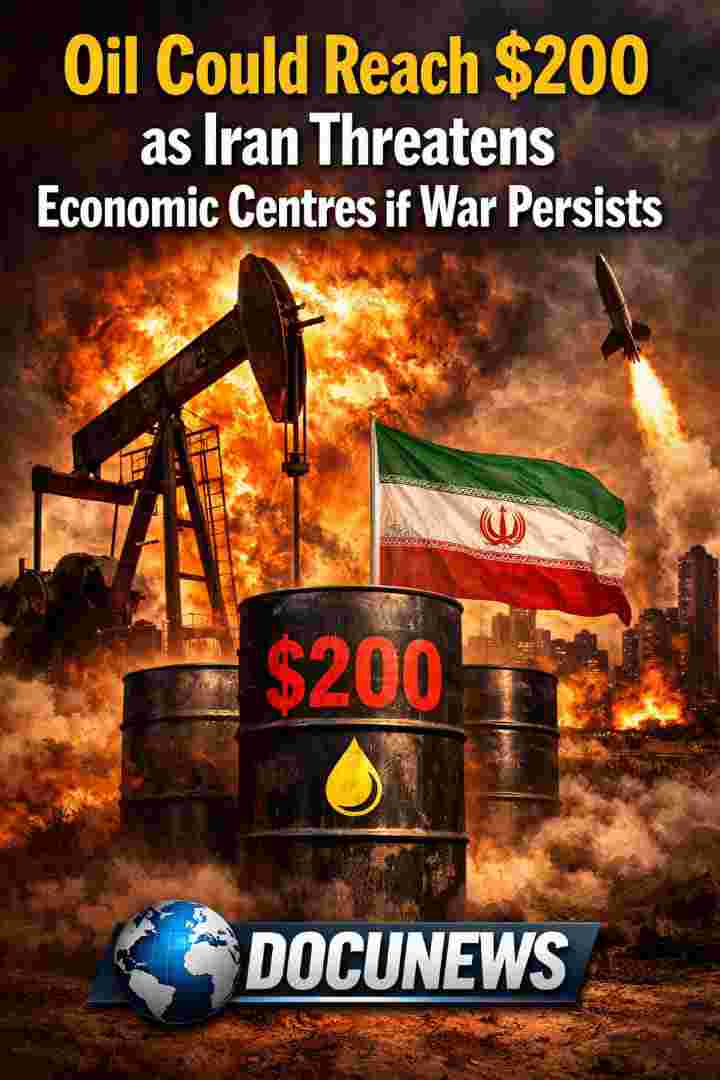
Oil Could Reach $200 as Iran Threatens Economic Centres if War Persists — this warning now dominates global headlines as rising tensions between Iran, the United States, and Israel shake energy markets. Crude prices already react sharply to every missile strike, diplomatic warning, and military movement. Analysts now caution that if hostilities expand toward major Gulf economic hubs, oil could surge toward the $200 mark, a level not seen in modern trading history.
On March 3, 2026. Leaders in Iran signaled that continued attacks by the United States and Israel could trigger direct strikes on strategic economic centres across the Middle East. Energy traders immediately reacted. Consequently, Brent crude climbed in early trading as fears of supply disruption intensified.
Markets now focus on one central issue. If this conflict spreads to oil infrastructure, how high can prices go? Investment banks, commodity analysts, and shipping firms now prepare for extreme volatility. Moreover, governments across Europe, Asia, and Africa review emergency supply plans.
Also Read Iran Confirms 787 Deaths as US-Israeli Airstrikes Devastate Cities
Oil Markets React to Rising War Risks
Energy markets never wait for confirmation. Instead, traders price in risk at the first sign of escalation. Therefore, crude futures spiked within hours of Tehran’s warning.
The Middle East controls nearly one-third of global oil supply. Furthermore, it hosts critical shipping lanes such as the Strait of Hormuz. If attacks target economic centres near ports, refineries, or export terminals, shipments could slow dramatically.
Brent crude recently traded above $120 per barrel. However, analysts now debate scenarios that push prices far beyond that range. Several commodity desks warn that a direct hit on major infrastructure could drive oil toward $150 quickly. In a worst-case scenario, some forecasts place crude near $200.
According to market data published by the International Energy Agency, global spare capacity remains limited. As a result, sudden supply shocks would strain inventories. Readers can review current oil supply assessments on the official IEA website: https://www.iea.org.
Why $200 Oil Is No Longer Unthinkable
A few years ago, $200 oil sounded unrealistic. Today, however, traders discuss it openly. Several factors support this possibility.
First, geopolitical concentration increases vulnerability. Saudi Arabia, the UAE, Kuwait, Iraq, and Qatar host critical production sites. Second, global demand remains strong despite economic slowdowns. Third, alternative supply routes cannot fully replace Gulf exports in the short term.
Moreover, history provides context. During previous crises, prices doubled within months. Although current reserves offer some buffer, prolonged disruption would erode that protection quickly.
Energy outlooks published by the U.S. Energy Information Administration show that even minor interruptions affect futures markets. Updated projections are available at: https://www.eia.gov.
Iran’s Strategic Warning and Regional Economic Hubs
Iran’s leadership framed its warning as a defensive response. Officials argued that continued attacks justify broader retaliation. However, targeting economic centres would mark a significant escalation.
Major Gulf cities serve as financial arteries for the region. They host sovereign wealth funds, stock exchanges, refineries, shipping terminals, and multinational headquarters. Consequently, any strike would send shockwaves through international markets.
Furthermore, insurers would likely increase maritime premiums. Shipping firms could reroute vessels. Banks might suspend regional financing temporarily. Each reaction would compound economic pressure.
Impact on Global Inflation
Higher oil prices ripple across every economy. Transportation costs rise immediately. Airlines adjust ticket prices. Food distribution becomes more expensive. Manufacturers face higher input costs.
If oil reaches $200, inflation could surge worldwide. Emerging markets would struggle most. Countries that import nearly all fuel would face severe currency pressure.
Central banks would confront difficult choices. Raise interest rates and slow growth? Or tolerate higher inflation to prevent recession? Either path carries consequences.
Effect on Nigeria and African Economies
For oil-producing nations like Nigeria, high prices bring both opportunity and risk. On one hand, government revenue would increase sharply. On the other hand, domestic fuel costs could still rise due to refining limitations.
Nigeria’s fiscal planners must therefore balance windfall earnings with inflation control. Moreover, currency stability remains crucial. If global uncertainty triggers capital flight, exchange rates may fluctuate.
For ongoing African economic coverage and geopolitical analysis, visit DocuNews Central.
Strait of Hormuz: The Chokepoint Factor
The Strait of Hormuz carries nearly 20 percent of global oil supply. Even limited disruption there would alarm markets.
Military tensions in this corridor historically caused dramatic price swings. Therefore, traders closely monitor naval movements and satellite imagery.
Maritime trade data and shipping regulations can be reviewed through the International Maritime Organization at: https://www.imo.org.
Energy Security in Europe and Asia
Europe already faces energy challenges following past supply disruptions. If Middle Eastern exports decline, competition for alternative sources would intensify.
Asian economies, especially China, Japan, and India, depend heavily on Gulf crude. Therefore, strategic reserves might come into play. Governments could release stockpiles temporarily to stabilize markets.
However, reserves only provide short-term relief. Sustained conflict would eventually exhaust emergency buffers.
Financial Markets and Investor Sentiment
Stock markets react quickly to geopolitical shocks. Energy companies often rise with oil prices. Meanwhile, airlines, logistics firms, and manufacturers face downward pressure.
Safe-haven assets such as gold typically gain during instability. Bond yields may fluctuate as investors reassess risk. Currency markets also respond quickly to supply fears.
DocuNews Central Opinion
At DocuNews Central, we believe the world stands at a fragile crossroads. Leaders must prioritize diplomacy before economic damage spirals beyond control. Markets already signal distress. Consumers already feel pressure.
Although strong rhetoric dominates headlines, cooler heads must prevail. War rarely delivers stability. Instead, it amplifies volatility, inflation, and human suffering.
Conclusion
Oil could reach $200 if Iran follows through on threats to strike Middle East economic centres and if the conflict with the United States and Israel persists. Markets already respond to risk signals. Supply chains remain vulnerable. Inflation pressures build.
However, outcomes still depend on political decisions made in the coming days and weeks. Diplomatic breakthroughs could stabilize prices. Escalation could send them soaring.
For more updates on the ongoing war visit