
Breaking news
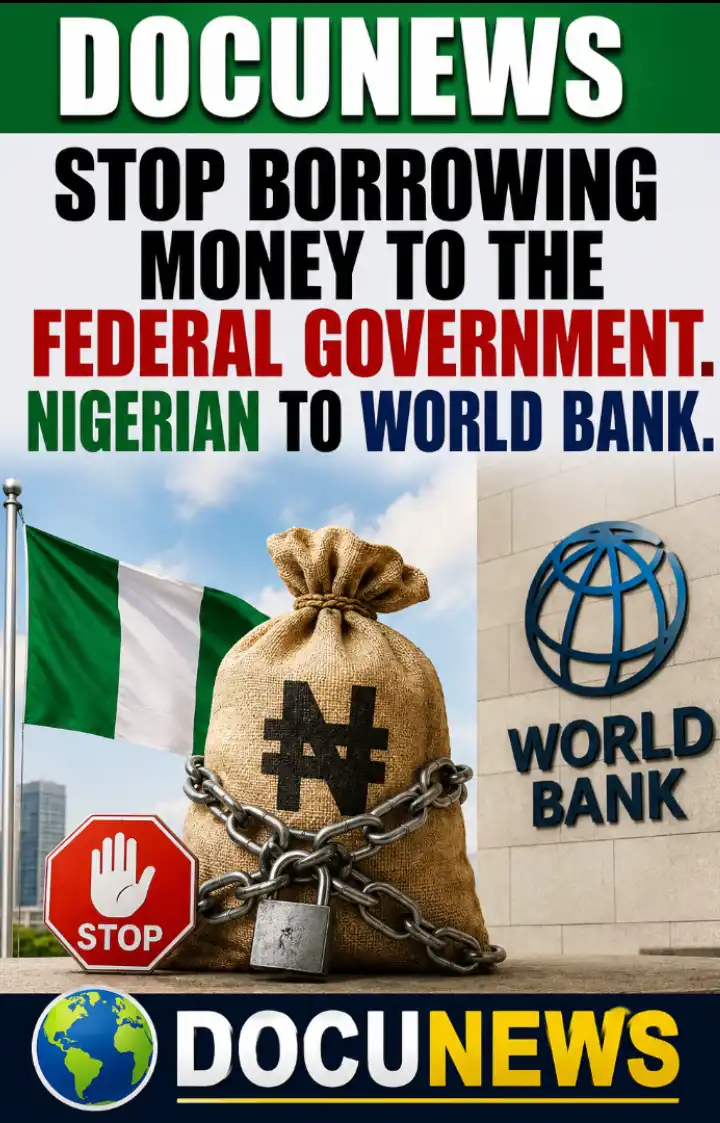
Stop Borrowing Money to the Federal Government, Nigerians Tell World Bank

By Jonadab | Published by DocuNews Central May 18, 2026
Nigerians mount online protest over new World Bank loan plan
Stop Borrowing Money to the Federal Government, thousands of Nigerians have turned to social media to urge the World Bank to stop approving new loans for Nigeria’s federal government. The online protest followed reports that the Federal Government is seeking a fresh $1.25 billion loan facility from the global lender.
Many of the comments appeared under recent posts published on the official World Bank social media pages, particularly Instagram. Citizens repeatedly asked the institution to halt further lending, arguing that rising debt has placed more pressure on the country’s economy while ordinary Nigerians continue to face hardship.
On May 13, 2026, in Abuja and across several online platforms, the reaction intensified after details of the proposed financing package became public. The development quickly became one of the most discussed economic issues in Nigeria this week.
What happened is straightforward. Nigerians publicly appealed to the World Bank to reject another loan request from Nigeria’s government. Where did it happen? The reaction began online but spread nationwide through social media conversations and political debate. Who is involved? Nigerian citizens, the Federal Government of Nigeria, and the World Bank Group.
Fresh $1.25 billion loan proposal triggers backlash
The latest facility under discussion is titled Nigeria Actions for Investment and Jobs Acceleration. Reports indicate that the proposed loan is expected to go before the World Bank board for review in June 2026.
However, public reaction was immediate. Many Nigerians said the country’s debt burden has become too heavy. Others argued that citizens rarely see direct benefits from previous loans.
According to data already published by Nigeria’s Debt Management Office, the country’s total public debt has continued to rise sharply over recent years. That increase has become a major source of concern among economists, business owners, and households.
As a result, citizens began posting thousands of comments directed at the World Bank. Several messages carried the same theme: “Stop lending money to Nigerian leaders.”
What Nigerians told the World Bank
DocuNews Central reviewed public comments posted under recent World Bank social media posts. The dominant message was consistent.
Some users wrote that new borrowing would only deepen Nigeria’s debt burden. Others argued that the country should focus on revenue generation instead of external financing.
Several commenters claimed that borrowed funds often fail to produce visible improvements in public services. While those claims remain political opinions, they formed a major part of the public anger.
One repeated phrase appeared frequently: “Do not borrow our government more money.” Another recurring message read: “You are lending politicians, not the Nigerian people.”
According to DocuNews Central, the volume of those reactions increased significantly after the proposed facility was widely reported by Nigerian media outlets.
World Bank limits social media comments
Following the flood of responses, users noticed that the World Bank restricted comments on some of its Instagram posts.
The action immediately drew more attention. Critics claimed the move was designed to limit public pressure. Others argued it was a routine moderation response to unusually high traffic.
The World Bank has not released a formal statement specifically addressing the comment restrictions.
Its broader position on lending remains unchanged. The institution says its loans are intended to support development, poverty reduction, infrastructure, and economic resilience.
Also read 42 Schoolchildren Abducted in Borno as Terrorists Strike Again
Why Nigerians are angry about borrowing
Nigeria’s current economic pressure explains much of the anger.
Inflation remains high. Food prices continue rising. Transport costs have increased sharply since fuel subsidy reforms began. At the same time, household incomes have struggled to keep pace.
Because of those pressures, many citizens believe new debt will eventually create additional tax burdens.
Some fear future generations will inherit repayment obligations without seeing present-day benefits.
Others point to earlier international loans and ask what measurable national gains followed those agreements.
Federal Government defends borrowing plans
Nigerian officials have defended external borrowing.
Government representatives argue that multilateral loans often carry lower interest rates and longer repayment periods than commercial borrowing.
They also insist that the funds are designed for infrastructure, social programmes, electricity expansion, digital access, and job creation.
Officials maintain that concessional financing remains necessary while economic reforms continue. That position has not eased public frustration.
Tinubu raises debt servicing concerns
President Bola Ahmed Tinubu recently acknowledged the pressure created by debt servicing.
During an international summit in Nairobi, he said Nigeria could spend about $11.6 billion on debt servicing in 2026. That amount could consume nearly half of projected government revenue.
He argued that African countries face unfair global borrowing costs and called for reform of international finance systems.
His remarks highlighted the same debt pressure that now fuels domestic public criticism.
Economic experts remain divided
Some economists say borrowing is not automatically harmful. They argue that strategic loans can stimulate growth if properly invested in productive sectors.
However, others warn that borrowing without strong accountability creates long-term fiscal risk.
Those analysts say public trust declines when citizens cannot identify visible outcomes tied to large loan approvals.
Authority reactions
Financial analysts in Nigeria say transparency will be central to restoring confidence.
Several policy experts have urged government agencies to publish clearer spending breakdowns for multilateral funds.
They say that detailed reporting could reduce suspicion and improve public trust.
According to DocuNews Central, accountability remains the central public demand emerging from this controversy.
What happens next
The World Bank board is expected to review the proposed facility in June 2026. Until then, public scrutiny is likely to continue. Nigerians online have made their position clear. They want stronger accountability before any new borrowing moves forward.
Whether that public pressure changes the lending decision remains uncertain.
For now, the message directed at the World Bank is unmistakable: stop approving more debt for Nigeria until citizens can see the value of existing loans.
for more detail please visit www.docunewscentral.com and Legit.ng