
Security updates Nigeria
Troops Foil ISWAP Assault, Rescue Kidnap Victims in North-East

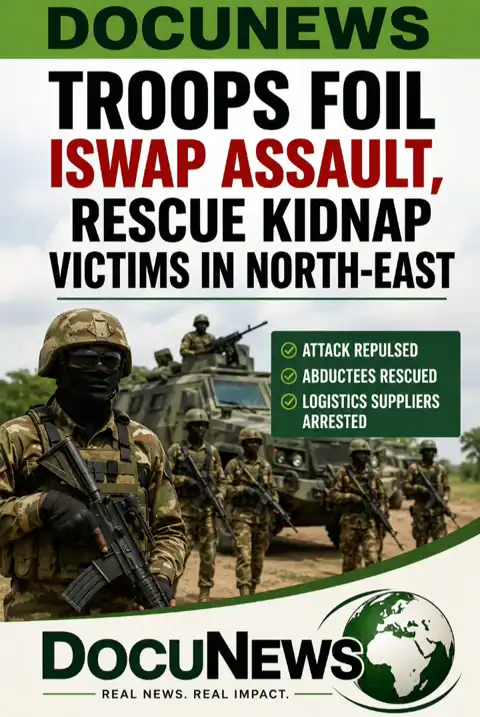
Nigerian troops have successfully foiled an attempted attack by fighters of the Islamic State West Africa Province (ISWAP) during a series of coordinated military operations across Nigeria’s North-East. The operations also resulted in the rescue of kidnapped civilians and the arrest of several suspected terrorist logistics suppliers believed to be supporting insurgent activities.
The latest military operation is another indication of the Armed Forces of Nigeria’s sustained efforts to dismantle terrorist networks and improve security across communities affected by insurgency. Security officials said the operation combined intelligence gathering, surveillance, and rapid tactical response to frustrate the terrorists before they could achieve their objective.
For years, North-East Nigeria has remained one of the country’s major security flashpoints due to the activities of terrorist groups. Although military offensives have significantly weakened many insurgent camps, security agencies continue to maintain pressure on the remaining cells to prevent them from regrouping.
Military Responds Swiftly to Intelligence
According to military sources, troops acted on credible intelligence indicating that ISWAP fighters were planning coordinated attacks on security positions and nearby communities.
Immediately after receiving the intelligence, troops launched well-coordinated operations aimed at intercepting the terrorists before they could strike. The operation involved extensive surveillance and careful movement through suspected terrorist routes.
When the terrorists attempted to engage security forces, Nigerian troops responded with superior firepower, forcing the insurgents to retreat from the area. The fierce confrontation disrupted the planned attack and prevented what could have resulted in significant casualties and damage.
Military authorities stated that the operation demonstrated improved coordination among units deployed across the North-East theatre of operations.
Terrorists Forced to Retreat
The exchange of gunfire reportedly lasted for some time before the terrorists abandoned their positions and fled into nearby bushes.
Security personnel immediately pursued the fleeing insurgents while conducting clearance operations around the affected areas to ensure no hidden threats remained.
Military sources explained that several items believed to belong to the terrorists were recovered during the operation. Although details of the recovered materials were not immediately disclosed, officials noted that intelligence gathered from the operation would assist future counterterrorism missions.
The successful response once again highlights the importance of intelligence-driven military operations in combating insurgency across the region.
Kidnapped Victims Rescued
One of the major outcomes of the operation was the successful rescue of civilians who had previously been abducted by terrorist elements.
The rescued victims were discovered during clearance operations carried out in suspected terrorist hideouts. Following their rescue, military medical personnel provided immediate humanitarian assistance while arrangements were made for further medical evaluation and support.
Authorities have not officially announced the identities or exact number of rescued victims, but military officials described the rescue as another important humanitarian achievement.
Kidnapping has remained one of the methods used by terrorist groups to spread fear, generate illegal income, and force communities into submission. Rescue operations therefore remain a critical part of the military’s broader counterinsurgency campaign.
Families of rescued victims are expected to be reunited with their loved ones after the completion of necessary security and medical procedures.
Suspected Logistics Suppliers Arrested
Apart from engaging terrorists directly, the operation also led to the arrest of several individuals suspected of providing logistical support to terrorist groups.
According to security officials, terrorist organizations depend heavily on logistics suppliers to sustain their operations. These individuals are often responsible for procuring food supplies, fuel, transportation, communication devices, medicines, clothing, and other materials needed by insurgent fighters.
The suspects are currently undergoing investigation to establish the extent of their involvement and identify possible links to other members of terrorist networks operating within the region.
Security experts have consistently maintained that disrupting logistics networks is one of the most effective strategies for weakening terrorist organizations. Without access to supplies and financial support, insurgent groups find it increasingly difficult to sustain prolonged operations.
The latest arrests therefore represent an important step toward dismantling the broader support structures that enable terrorism.
Military Sustains Pressure on Terrorist Groups
The Armed Forces of Nigeria have continued to intensify offensive operations against terrorist groups across the North-East.
These operations involve coordinated land patrols, intelligence surveillance, clearance missions, and targeted raids on suspected insurgent camps.
The objective remains to eliminate terrorist hideouts, recover illegal weapons, rescue abducted civilians, and restore normal life to communities that have suffered years of insecurity.
Military authorities have repeatedly emphasized that sustained operational pressure is necessary to prevent terrorists from reorganizing after previous defeats.
Recent operations suggest that security agencies are increasingly focusing not only on armed fighters but also on the financial and logistical networks that support terrorist activities.
Security Challenges Persist
Despite the latest military success, security analysts acknowledge that the fight against terrorism remains an ongoing challenge.
ISWAP continues to adapt its operational tactics by relying on smaller mobile units, surprise attacks, and hidden supply chains.
Rather than attempting to occupy large territories as in previous years, the group has increasingly relied on ambushes, kidnappings, and attacks on isolated communities and security formations.
This changing pattern requires continuous intelligence gathering, technological surveillance, and strong collaboration between military personnel and local communities.
Experts believe sustained investment in intelligence capabilities will remain essential for long-term success against insurgent groups.
Also read Defence Minister Reveals That Bandits Threatened to Kill Abducted Oyo Pupils During Rescue Mission.
Community Support Remains Essential
Security agencies have again urged residents across North-East Nigeria to continue supporting ongoing military operations by providing credible information regarding suspicious individuals or unusual movements.
Timely intelligence from local communities has repeatedly contributed to successful rescue missions and the prevention of planned terrorist attacks.
Authorities encouraged residents to promptly report suspicious activities through appropriate security channels while avoiding unnecessary risks.
Community engagement remains one of the most important components of modern counterterrorism strategies because local residents are often the first to notice unusual activities within their environment.
Officials also appealed for continued cooperation with security personnel conducting routine patrols and clearance operations.
Government’s Commitment to Restoring Peace
The Federal Government has consistently reaffirmed its commitment to restoring lasting peace across regions affected by insurgency.
Beyond military operations, authorities continue to support humanitarian programmes designed to assist displaced persons, rebuild damaged communities, and strengthen economic recovery.
Security experts argue that defeating terrorism requires a comprehensive approach that combines military action with improved education, employment opportunities, infrastructure development, and community resilience.
While military victories remain important, long-term stability will also depend on addressing the social and economic conditions that extremist groups often exploit.
The latest operation in which troops foiled an ISWAP assault, rescued kidnapped civilians, and arrested suspected terrorist logistics suppliers represents another significant achievement in Nigeria’s ongoing counterterrorism efforts.
Although security challenges remain across parts of the North-East, the operation demonstrates the growing effectiveness of intelligence-led military strategies aimed at protecting communities and disrupting terrorist activities.
As security agencies continue offensive operations, authorities remain optimistic that sustained pressure on both insurgent fighters and their support networks will further reduce the operational capacity of terrorist groups.
The Armed Forces of Nigeria have reaffirmed their commitment to safeguarding lives and property while ensuring that terrorist organizations are denied the opportunity to regroup or launch fresh attacks.
Residents across the North-East have also been encouraged to remain vigilant and continue working closely with security agencies. Through cooperation, timely intelligence, and sustained military operations, authorities believe Nigeria can continue making meaningful progress in the fight against terrorism and create safer communities for millions of citizens.
For more Updates, please visit Security updates Nigeria and www.vanguard.com