
Security
Boko Haram Attacks Nigerian Army Base in Borno, Several Soldiers Killed, Gun Trucks Destroyed

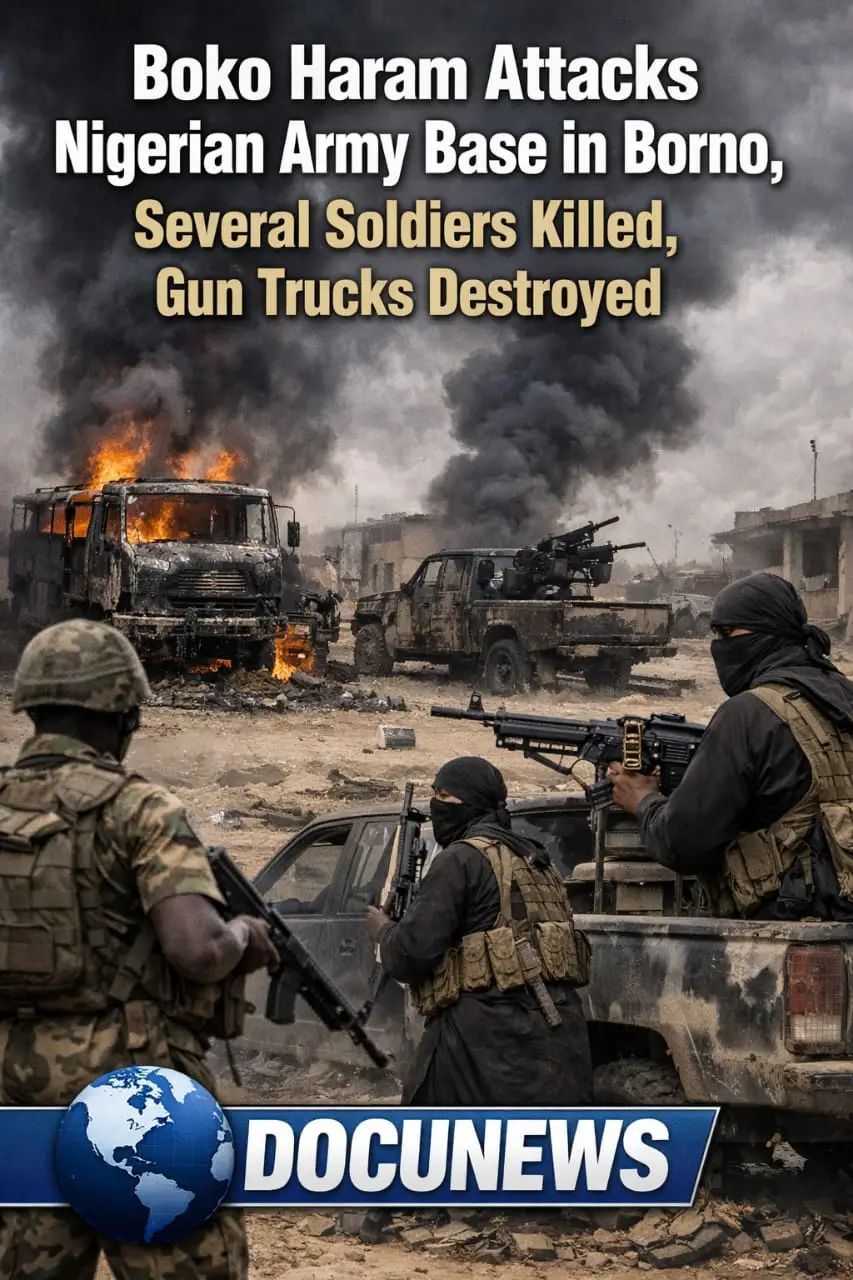
Photo Credit Visit Disclaimers: Use Of AI Images In Our Newsletters
Boko Haram Attacks Nigerian Army Base in Borno, Several Soldiers Killed, Gun Trucks Destroyed
In a deadly and dramatic assault, Boko Haram attacked a Nigerian Army base in Borno State, killing several soldiers and destroying multiple gun trucks in a violent clash that underscores the deepening insurgency threat in Nigeria’s northeast. This alarming incident has immediately drawn national and international attention, prompting intense scrutiny of security operations and tactical readiness along the insurgency frontlines.
On January 29, 2026, militants linked to Boko Haram’s ISWAP faction launched a coordinated strike at a military formation in Sabon Gari, Damboa Local Government Area, Borno State, Nigeria. The attackers engaged troops with sustained fire, inflicted casualties, and set fire to armoured vehicles before withdrawing into surrounding terrain, according to military sources and eyewitnesses. The scale of the attack and subsequent losses have raised urgent questions about tactical vulnerabilities and the evolving threat landscape in the region.
Read more Janbross, Notorious Zamfara Bandit Behind Mass Kidnapping of 20
How the Attack Unfolded
At first light on that fateful morning, insurgents moved swiftly toward the well‑established Nigerian Army base. Armed with machine guns, RPGs and other heavy weapons, they initiated violence with overwhelming firepower. Soldiers stationed at the base immediately scrambled to mount a defense, returning fire and attempting to hold key positions throughout the compound.
Despite their efforts, the intensity of the assault forced defenders into a reactive posture. Militants executed the attack with clear planning and strong coordination. They surrounded the base perimeter, cut off lines of reinforcement, and advanced through multiple gate checkpoints. Civilians in nearby communities reported hearing bursts of automatic gunfire followed by explosions that shook homes and businesses.
Eyewitness accounts describe billowing smoke and flames ascending from within the base, evidence that militants successfully breached armored divisions and ignited gun trucks that once served as crucial military assets. Many of these vehicles were left beyond repair, their charred shells reinforcing the severity of the confrontation. Observers note that such attacks are becoming increasingly bold, indicating an insurgency emboldened by prior successes and a sophisticated understanding of military weak points.
You may have missed this Nigerian Army Storms Kwara Bandit Camps, Rescues Kidnap Victims
Confirming Casualties and Damage
Military officials have confirmed that several Nigerian soldiers lost their lives during the skirmish. While exact figures remain under review, multiple field sources suggest the number of fallen personnel could be higher than initial tallies. Some soldiers sustained severe injuries, and ongoing recovery operations continue to bring clarity to the full scale of losses. These casualties represent not only a human tragedy but also a strategic setback in the fight against insurgents, as experienced troops are invaluable for maintaining defensive readiness in volatile regions.
The militants also reportedly seized ammunition and other equipment, further compounding the security concerns surrounding the engagement. Footage and photos shared by local residents on social media platforms captured thick smoke rising from the wreckage long after the battle ended, painting a grim scene of destruction and abandonment. Analysts suggest that such seizures allow Boko Haram to replenish supplies without depending on external smuggling networks, making each attack more sustainable.
For deeper coverage of military operations and security challenges across Nigeria, visit DocuNews Central, where evolving reports and contextual narratives provide broader insight into ongoing conflicts and national developments.
Prior Attacks and Emerging Patterns
This attack is not an isolated incident. Only days earlier, on January 26, Boko Haram fighters ambushed soldiers in another area of Borno State. According to international reporting, that clash resulted in the death of seven Nigerian soldiers and the capture of 13 others. See the Reuters report for additional details.
Analysts note that Boko Haram’s use of ambush tactics, improvised explosive devices, and surprise attacks against military formations has grown more sophisticated over time. In some recent incidents, the insurgents have even deployed drones or modified aerial devices to complicate defensive responses, a stark indication of tactical evolution within the insurgency ranks. Experts warn that without continuous adaptation, conventional military bases remain highly vulnerable, particularly when insurgents exploit local geography, such as dense bush and riverine areas, for tactical advantage.
As security forces adapt to these changing tactics, the need for robust intelligence and enhanced defense coordination has never been clearer. Leaders both within and outside the Nigerian military continue to evaluate strategic shifts intended to counter the insurgents’ dynamic approaches. This includes integrating surveillance technology, bolstering rapid reaction forces, and increasing coordination with civil authorities to ensure early warnings and community alert systems.
You may missed the Nigerian Army Storms Kwara Bandit Camps, Rescues Kidnap Victims
Historical Context of Boko Haram Insurgency
Boko Haram has been active in Nigeria since 2002, with the insurgency intensifying from 2009 onward. The group has orchestrated numerous attacks on military bases, schools, markets, and religious institutions, aiming to destabilize the northeastern region. Its ideology is rooted in establishing an Islamist state, rejecting Western-style governance and education, which has fueled decades of conflict. Analysts suggest that recurring attacks on military targets reflect both symbolic and tactical objectives—weakening state presence while boosting the insurgents’ local and international notoriety.
The split between the original Boko Haram faction and the ISWAP subgroup has further complicated counterinsurgency efforts. ISWAP, which claims affiliation with the Islamic State, often targets military personnel more selectively, whereas the original faction sometimes focuses on civilian targets. This division has led to a varied pattern of attacks, creating unpredictable security challenges across Borno, Yobe, and Adamawa states.
Local and Regional Impact
The impact of repeated attacks extends well beyond military casualties. Communities near conflict zones experience a profound human cost as daily life, local economies, education systems, and social cohesion deteriorate under the shadow of persistent violence. Parents keep children home from school out of fear. Farmers abandon fertile fields. Markets shrink into ghost towns. These are just some of the cascading effects experienced across northeast Nigeria. In addition, psychosocial trauma from recurrent violence leaves lasting scars, particularly among children who witness attacks or lose family members.
Humanitarian organizations working in the region have repeatedly highlighted the link between continuous insecurity and worsening food shortages, displacement, and strain on public health infrastructure. With limited access to remote communities, aid groups often struggle to deliver essential food, medical care, and shelter supplies to civilians in need. According to the United Nations Office for the Coordination of Humanitarian Affairs (OCHA), the northeast region continues to host hundreds of thousands of internally displaced persons, a population highly vulnerable to both physical insecurity and disease outbreaks.
To understand the broader humanitarian consequences, visit the United Nations Office for the Coordination of Humanitarian Affairs page on displacement in northeast Nigeria and Lake Chad Basin countries.
Government and Military Response
The Nigerian Army has maintained silence on specific casualty figures in the wake of the attack, citing ongoing operations and sensitivity around intelligence disclosures. Historically, military leadership releases verified statistics only after thorough verification, which can take time amid active field engagements. Nonetheless, the government has emphasized its determination to sustain counterinsurgency efforts despite setbacks.
High‑ranking officials, including the President, have consistently reiterated their commitment to degrade insurgent capabilities and protect citizens. Critics, however, argue that persistent attacks reveal gaps in planning, logistics, and real‑time intelligence coordination. They insist that structural reforms and community partnership strategies are essential if meaningful progress is to be achieved. Observers suggest that enhancing local intelligence networks and fostering collaboration with village defense groups could provide vital early warning capabilities to preempt future assaults.
Strengthening Defense Posture
In response to this most recent assault, military strategists are reportedly reviewing defense postures at forward operating bases and outposts across Borno State and adjacent areas. These reviews encompass:
- Enhancing perimeter security and surveillance, including the use of CCTV, drones, and motion sensors
- Deploying rapid response units to high‑risk zones, capable of quick reinforcement during surprise attacks
- Increasing aerial reconnaissance and logistics support, ensuring timely resupply of fuel, ammunition, and medical resources
- Integrating local civilian defense personnel into intelligence sharing networks, leveraging community insights to track insurgent movements
- Reinforcing communication networks for faster alarm escalation, including encrypted mobile systems and satellite links
At the same time, cooperation with neighboring states — including Cameroon, Chad, and Niger — continues through joint task forces and shared security operations. Cross‑border coordination aims to thwart militants who move fluidly across international borders to stage surprise attacks or regroup in less fortified regions. Analysts emphasize that regional cooperation is essential, as insurgents frequently exploit porous borders and remote terrain to evade Nigerian military operations.
For insights into military strategies across the region, explore the U.S. Department of Defense reports on counter‑insurgency collaboration in Africa.
Voices from Affected Communities
Residents in and around Damboa have shared first‑hand accounts of the attack’s immediate aftermath. Many described waking to the sound of gunfire and explosions, moments that shattered the early morning quiet and plunged families into fear and uncertainty. One community leader reported seeing long columns of smoke rising from the base and hearing desperate calls for help from soldiers and volunteers still pinned down hours after the main fighting subsided.
Local humanitarian volunteers also described the chaotic response in nearby villages, where civilians rushed to secure food, water, and shelter amid rising tensions. These accounts underscore the unpredictable nature of violence in conflict zones and the deep emotional toll borne by those living in the insurgency’s wake. Communities also noted challenges in mobilizing emergency medical support, as roads were often blocked or unsafe due to ongoing skirmishes, prolonging treatment for the injured.
International Coverage and Perspective
International media outlets have continued to place Boko Haram’s resurgence in the context of broader regional instability. For example, Reuters and BBC News Africa have both highlighted how recent ambushes on Nigerian troops reflect ongoing adaptive tactics used by insurgent groups.
Experts in African security issues emphasize that the conflict’s persistence highlights underlying socioeconomic challenges such as unemployment, inequality, and limited access to education. While kinetic military operations remain critical, they must accompany long‑term development and governance reforms to create sustainable peace. Programs promoting vocational training, youth engagement, and infrastructure development are increasingly seen as essential complements to military action.
What Happens Next?
Following attacks like this one, militaries typically carry out a series of actions, including:
- Recovering the wounded and fallen
- Conducting forensic assessments of the attack route, including blast patterns and entry points
- Reinforcing neighbouring bases with additional troops and equipment
- Re‑evaluating intelligence and surveillance protocols
- Increasing outreach with local communities for trust building, early warning, and coordination
Each of these steps aims to not only secure territorial defence but also to prevent repeat assaults through forward planning and adaptive strategy. Meanwhile, authorities continue to urge civilians to cooperate with security forces and report suspicious activities promptly, recognizing that community vigilance is a crucial layer of national defense.
How to Stay Informed
To follow ongoing developments, readers can monitor real‑time reporting through major international outlets such as:
- Reuters – global news with verified reporting
- BBC News Africa – regional focus and contextual coverage
- Al Jazeera – in‑depth perspectives on West African conflict dynamics
For localized, investigative narratives that provide broader context to Nigeria’s security landscape, visit DocuNews Central, where news analysis and expert commentary help readers stay informed about evolving challenges across the nation.
Final Thoughts
The attack on the Nigerian Army base in Borno on January 29, 2026 serves as a somber reminder of the enduring threats facing the nation’s northeast region. While military commanders and political leaders vow to intensify operations and reinforce defenses, insurgent groups continue to adapt and exploit vulnerabilities. Achieving lasting peace will require not only military strength but also strategic collaboration, social investment, and community engagement. Only through a comprehensive approach that addresses security, governance, and economic opportunity together can the cycle of violence begin to recede.
As the nation continues to grapple with these challenges, it is imperative for both domestic authorities and international partners to prioritize preventive strategies, strengthen local resilience, and invest in human security alongside conventional military measures. The path to stability in Borno and the broader northeast remains complex, but a sustained and holistic effort can mitigate threats and build the foundation for lasting peace.
