
Breaking news
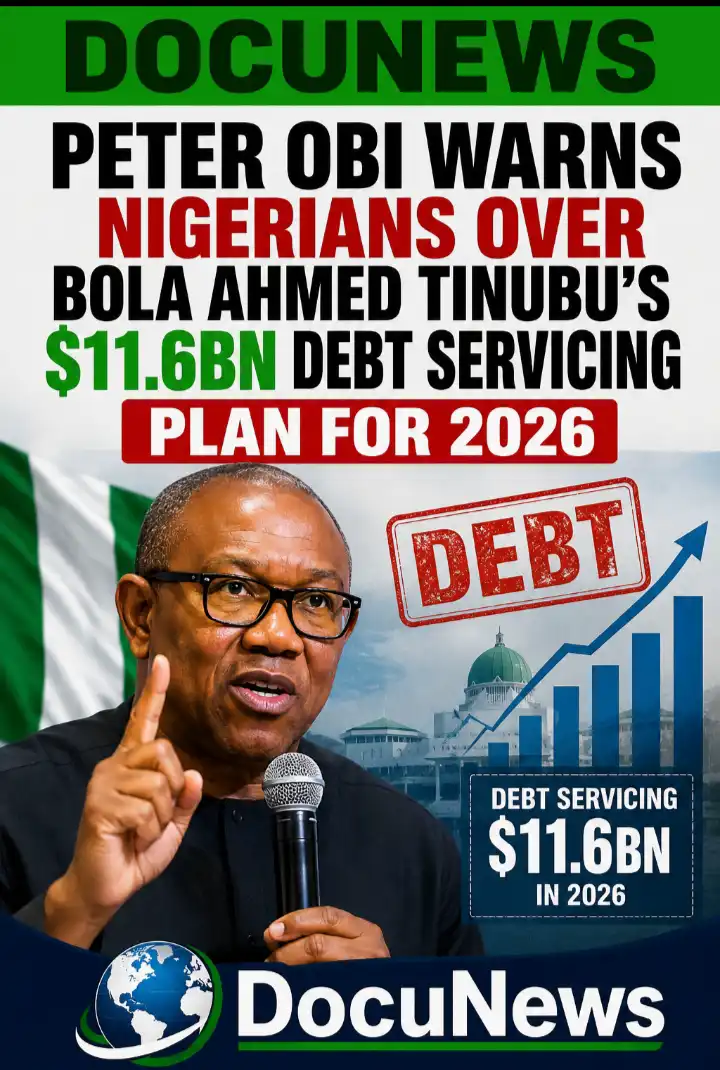
Peter Obi Warns Nigerians Over Bola Ahmed Tinubu’s $11.6bn Debt Servicing Plan for 2026

By Jonadab | Published by DocuNews Central May 19, 2026
Peter Obi Raises Concern Over Nigeria’s Planned Debt Servicing in 2026
Former Anambra State Governor Peter Obi has expressed concern over Nigeria’s planned $11.6 billion debt servicing obligation for 2026. He said the development should worry Nigerians because of its possible impact on national development priorities.
Obi made the statement on Monday through his verified X account. He reacted after President Bola Ahmed Tinubu announced that Nigeria would spend approximately $11.6 billion on debt servicing next year.
On May 18, 2026, in Abuja, Nigeria, Obi said the projected repayment burden raises serious questions about fiscal priorities under the current administration.
According to DocuNews Central, Obi stated that borrowing itself is not the core problem. Instead, he explained that the concern lies in how borrowed funds are used and whether they generate measurable economic growth.
What Happened?
Peter Obi criticised the Federal Government’s debt servicing plan for 2026. He warned that the country’s planned expenditure of $11.6 billion on debt repayment could weaken investment in social and productive sectors.
He argued that government borrowing should fund projects that expand economic output. However, he said much of Nigeria’s borrowing has gone toward recurrent spending and consumption.
Where Did It Happen?
The comments were made publicly through Obi’s official social media platform in Nigeria. His remarks followed President Tinubu’s earlier speech at the Africa Forward Summit in Nairobi, Kenya.
Who Is Involved?
The issue involves former Anambra State Governor Peter Obi and Nigerian President Bola Ahmed Tinubu. It also directly affects Nigeria’s fiscal authorities, investors, lenders, and citizens.
Tinubu’s Earlier Announcement Triggered the Debate
President Bola Ahmed Tinubu first disclosed the debt servicing estimate during the Africa Forward Summit held in Nairobi. During that address, he stated that Nigeria would spend about $11.6 billion on debt servicing in 2026.
According to the Presidency, nearly half of projected government revenue may go toward debt obligations. That figure immediately triggered reactions among economists and opposition figures.
Channels Television first reported Tinubu’s statement during the summit. The announcement drew attention because of its scale and its implications for Nigeria’s fiscal future.
Also read Peter Obi Stands Unopposed as NDC Sole Presidential Aspirant
Source: Channels Television www.docunewscentral.com
Peter Obi Questions Fiscal Priorities
Obi compared the proposed debt servicing amount with allocations to essential sectors. He noted that the 2026 federal budget allocates about ₦2.46 trillion to health, ₦2.56 trillion to education, and ₦865 billion to poverty alleviation.
Combined, those three sectors total approximately ₦5.885 trillion. By comparison, Obi said the projected debt servicing bill translates to roughly ₦17 trillion to ₦18 trillion, depending on the exchange rate.
That comparison formed the basis of his criticism. He argued that debt obligations now risk crowding out spending on human capital.
External Borrowing Figures Highlighted
Obi also listed recent external borrowing commitments. According to his statement, they include approximately $5 billion from First Abu Dhabi Bank and $1 billion through UK Export Finance via Citibank London.
He added that the government is reportedly considering another $1.25 billion from the World Bank. In addition, about $516 million was reportedly arranged through Deutsche Bank.
Those figures, according to Obi, push recent external commitments close to $7.8 billion.
Economic Analysts Share Similar Concerns
Several Nigerian economists have repeatedly warned about rising debt servicing costs. They argue that high debt repayments limit government flexibility and reduce capital available for infrastructure and social investment.
Economic analyst Dr. Muda Yusuf previously stated that debt sustainability depends on revenue growth and productive use of loans. He noted that debt itself is not dangerous unless repayment begins to overwhelm national income.
That concern appears central to Obi’s latest warning.
Government Position on Borrowing
The Federal Government has defended its borrowing strategy. Officials maintain that Nigeria needs external and domestic financing to support infrastructure development and macroeconomic reforms.
President Tinubu has also argued that global lending conditions unfairly disadvantage African countries. He said many developing nations pay higher interest rates than wealthier economies.
That remains part of the administration’s broader economic reform argument.
Why the Issue Matters
Nigeria’s debt servicing obligations affect public services directly. When repayment consumes a large share of national revenue, fewer resources remain for education, healthcare, roads, and social support.
Therefore, fiscal planning has become a major political issue ahead of future elections. Opposition leaders are expected to continue using debt management as a policy debate point.
According to DocuNews Central, the discussion now reflects a broader national concern about balancing debt obligations with development priorities.
Official Sources and Verification
This report was compiled using verified public statements from Peter Obi’s official X account, official remarks from President Bola Ahmed Tinubu, and published reports from recognised national media outlets.
Primary source material was reviewed through Channels Television’s published reports and cross-checked with publicly available government statements.
Sources: