
World
Qatar, Kuwait, UAE and Bahrain Risk Running Out of Air Defense Interceptors as Iran Escalates Attacks

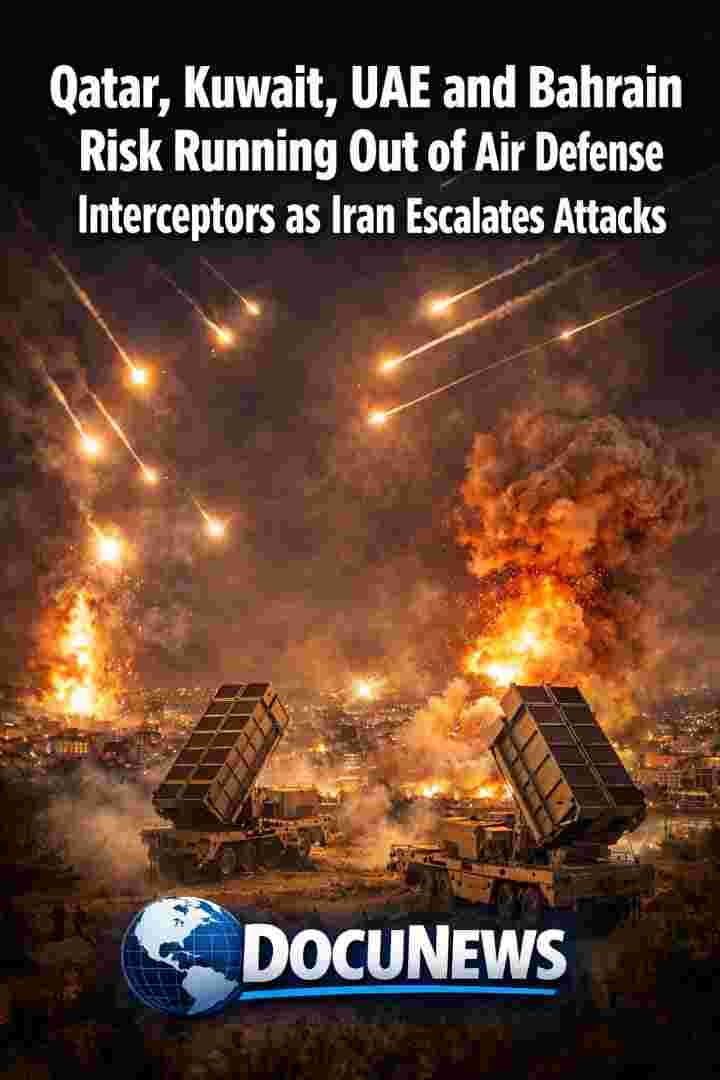
What will happen if Qatar, Kuwait, UAE and Bahrain Run Out of Air Defense Interceptors as Iran Escalates Attacks. This has become the defining security story in the Middle East as Iran missile attacks, ballistic missile strikes, and drone warfare escalation continue at a relentless pace. Defence analysts now warn that the sustained barrage could exhaust critical air defense interceptors across the Gulf within days if the current tempo continues. Although advanced US-made air defense systems have intercepted many incoming threats, the rate of fire has raised urgent questions about stockpile sustainability and long-term regional stability.
According to DocuNews Central, On March 4, 2026. Officials across Qatar, Kuwait, United Arab Emirates and Bahrain have intensified consultations with defence partners after Iran launched waves of ballistic missiles, cruise missiles, and kamikaze drones across strategic corridors. Tehran’s offensive followed coordinated strikes by the United States and Israel on Iranian-linked assets. As a result, the Gulf now faces a dangerous test of endurance in a rapidly evolving Middle East missile crisis.
Regional military planners acknowledge that the immediate threat remains manageable. However, they also admit that interceptor depletion presents a serious risk if resupply lines slow or if attacks expand.
Also read Iran Confirms 787 Deaths as US-Israeli Airstrikes Devastate Cities
Escalating Iran Missile Attacks Strain Gulf Air Defense Systems
First, the numbers matter. Iran has launched hundreds of projectiles in coordinated waves. These attacks include medium-range ballistic missiles, low-flying cruise missiles, and explosive drones designed to overwhelm radar networks. Consequently, Gulf states have activated layered air defense systems to protect cities, oil facilities, airports, and military installations.
Most interceptions rely on advanced American-built platforms. These systems cost millions of dollars per unit. Moreover, each defensive missile can exceed the value of the incoming drone several times over. Therefore, the economic imbalance intensifies the strategic challenge.
At the same time, commanders must decide which targets demand immediate interception and which pose limited danger. That split-second judgment shapes stockpile consumption. If every incoming object triggers a launch, inventories decline quickly. If they hesitate, vital infrastructure could suffer damage.
Because Iran continues firing in waves, Gulf air crews have little downtime. As a result, maintenance schedules tighten. Crews rotate under stress. Logistics teams scramble to track remaining interceptor counts. In effect, the region has entered a war of endurance rather than a single exchange.
Why Air Defense Interceptors Matter in Modern Warfare
Air defense interceptors serve as the backbone of territorial protection. Without them, even a small number of ballistic missiles can strike strategic energy hubs. In the Gulf, energy infrastructure anchors both regional and global markets. Therefore, protecting refineries, export terminals, and gas facilities ranks as a top priority.
Furthermore, ballistic missile defense relies on layered architecture. Long-range systems target threats outside the atmosphere. Medium-range interceptors engage within the upper airspace. Short-range units defend against drones and low-flying cruise missiles. If one layer weakens, the entire shield becomes vulnerable.
Iran’s strategy appears designed to stretch that shield. By mixing drones with advanced missiles, Tehran forces defenders to spend high-value interceptors on relatively low-cost threats. Consequently, Gulf states face a supply dilemma.
In addition, procurement cycles for replacement interceptors often take months. Manufacturing capacity remains finite. Export approvals require diplomatic coordination. Thus, even wealthy nations cannot replenish overnight.
For deeper defence procurement insights, visit the International Institute for Strategic Studies at https://www.iiss.org and the Stockholm International Peace Research Institute at https://www.sipri.org.
You may have missed this Iran’s New Leader Arafa Says Negotiations With Trump Are Over
The Economic Cost of Sustained Missile Defense
The financial burden of continuous interception continues to rise. Each launch consumes expensive munitions. Meanwhile, Iran’s drones cost far less to produce. Therefore, the cost asymmetry favors the attacker in prolonged scenarios.
Energy markets have already reacted to the growing Middle East crisis. Investors monitor risks to oil shipments and liquefied natural gas exports. Even limited damage could disrupt supply chains. As a result, governments now balance military expenditure with economic stability.
Qatar leads global liquefied natural gas exports. The United Arab Emirates operates key port facilities and aviation hubs. Kuwait and Bahrain also host critical energy and naval assets. Because of that interconnected network, interceptor shortages could carry global consequences.
For energy market data and analysis, visit the U.S. Energy Information Administration at https://www.eia.gov.
Military Readiness and Strategic Calculations
Despite mounting pressure, Gulf militaries emphasize readiness. Commanders insist that current stockpiles remain operational. However, they also acknowledge the need for accelerated replenishment.
The United States has increased coordination with regional allies. Joint defense planning sessions continue daily. Moreover, intelligence sharing now operates around the clock. That cooperation enhances radar coverage and early warning detection.
Nevertheless, Iran maintains the initiative through tempo. By sustaining frequent launches, Tehran keeps defensive systems active and strained. This tactic mirrors previous conflicts where missile saturation aimed to exhaust defenses before major escalation.
Civilian Protection and Urban Defense
Beyond military targets, governments prioritize civilian safety. Airports, residential districts, and commercial centers rely on interceptor coverage. Therefore, authorities have implemented emergency drills and shelter advisories.
So far, interception rates remain high. However, even a small breakthrough could cause casualties. Because drones often fly at low altitude, detection windows shrink. That factor increases tension in densely populated areas.
Public communication strategies now emphasize preparedness without panic. Officials provide regular updates while discouraging misinformation. Social media monitoring teams also counter false reports.
Diplomatic Channels and De-escalation Efforts
While missiles dominate headlines, diplomacy continues behind closed doors. Gulf states maintain dialogue with Washington and European partners. Meanwhile, mediators attempt indirect communication with Tehran.
Iran argues that its campaign responds to earlier strikes on its facilities. However, Gulf governments stress that continued attacks threaten broader stability. As a result, calls for ceasefire discussions have grown louder.
For diplomatic updates, readers can consult the United Nations at https://www.un.org and the U.S. Department of State at https://www.state.gov.
Supply Chains and Manufacturing Constraints
Another pressing issue involves production capacity. Interceptors require advanced components. Semiconductor chips, propulsion systems, and guidance mechanisms demand specialized manufacturing. Consequently, scaling output takes time.
Moreover, global defense supply chains already face strain from multiple conflicts. Therefore, even urgent orders may encounter delays. Gulf states have begun reviewing alternative suppliers, yet compatibility with existing systems limits options.
In the meantime, defense ministries monitor usage rates daily. Some analysts believe that if the current pace continues for several more weeks, certain units could reach critical thresholds.
Strategic Energy Infrastructure at Risk
The Gulf region hosts some of the world’s largest oil and gas facilities. Therefore, missile defense coverage concentrates heavily around energy assets. Ports, pipelines, refineries, and offshore platforms rely on layered shields.
Insurance firms track these developments closely. Higher risk assessments translate into increased premiums. That cost ultimately affects global consumers.
DocuNews Central Opinion
DocuNews Central believes that the current Iran missile escalation marks a pivotal moment for Gulf security architecture. The reliance on imported interceptors exposes structural vulnerabilities. Although regional forces demonstrate strong defensive performance, sustainability remains the true challenge.
Therefore, Gulf nations should accelerate joint procurement programs. They should expand domestic defense manufacturing partnerships. They should also strengthen diplomatic channels to reduce escalation triggers.
Conclusion
The headline Qatar, Kuwait, UAE and Bahrain Risk Running Out of Air Defense Interceptors as Iran Escalates Attacks captures a rapidly unfolding reality. Sustained Iran ballistic missile attacks, combined with relentless drone strikes, have placed Gulf air defense systems under exceptional strain. Although interception rates remain high, stockpile sustainability raises urgent concern.
As diplomatic efforts continue and defense partnerships intensify, the coming days will determine whether the region stabilizes or slides deeper into crisis. The Middle East now stands at a strategic crossroads where endurance, logistics, and diplomacy carry equal weight.
Disclaimer: This report is based on available security assessments, defence expert analysis, and publicly accessible information at the time of publication. Ongoing military developments may alter circumstances rapidly. DocuNews Central provides this content for informational purposes only and does not claim access to classified military data. Readers should consult official government statements and verified defense sources for real-time updates.
