
Security updates Nigeria
Army Links Cattle Markets to Boko Haram Funding

By Jonadab | DocuNews Central
Published: 2026-05-12T10:00:00+01:00
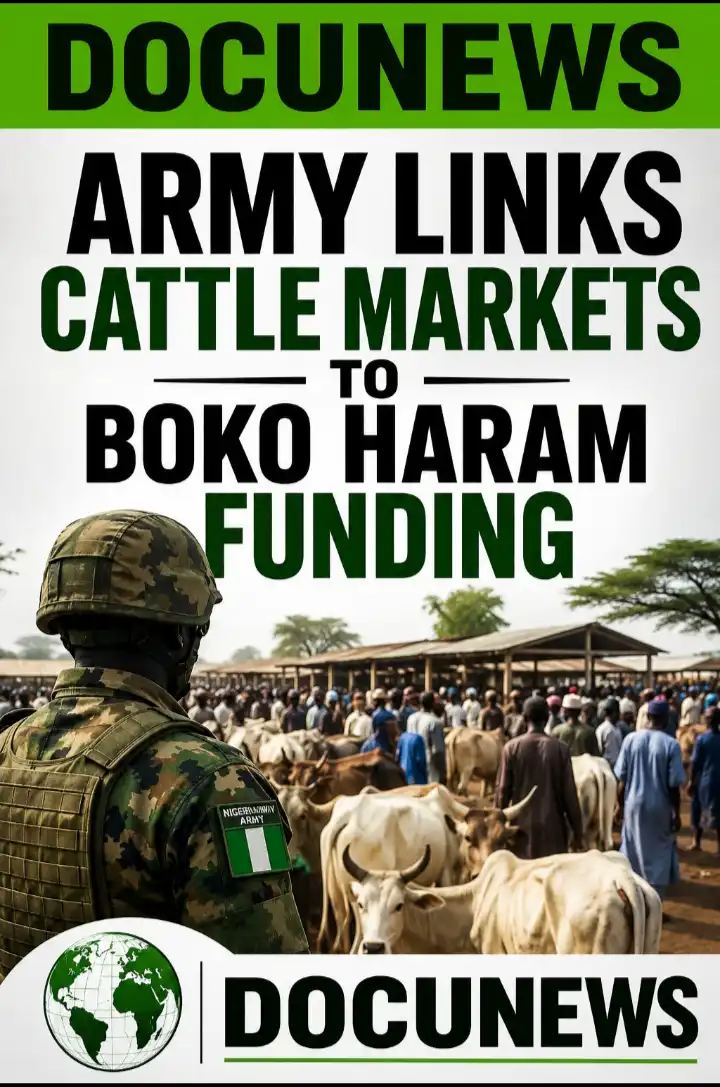
Army Links Cattle Markets to Boko Haram Funding. According to military intelligence findings, cattle markets and civilian trading channels have played an indirect but significant role in funding insurgent activities.
Furthermore, security officials explained that these markets often serve as convergence points where illicit transactions are concealed within legitimate livestock trade. As a result, tracking financial flows linked to insurgent groups has become more complex for intelligence units operating in the region.
On 2026-05-12T10:00:00+01:00 in Maiduguri, Borno State, military officials briefed reporters on ongoing investigations into terror financing structures operating across rural trading hubs in the North-East. The briefing highlighted the suspected link between informal livestock trade and Boko Haram logistical support networks.
What Happened?
The Nigerian Army reported that Boko Haram receives indirect financial support through cattle trading routes and market transactions in affected states. Investigators identified patterns suggesting that insurgents exploit rural economies to sustain mobility, recruitment, and logistics.
In addition, the army confirmed that several arrests and surveillance operations revealed hidden financial exchanges tied to livestock sales. Consequently, authorities intensified monitoring of major cattle markets across Borno, Yobe, and Adamawa states.
Where Did It Happen?
The findings cover multiple locations across Nigeria’s North-East, particularly in Borno, Yobe, and Adamawa states. These areas remain the epicenter of Boko Haram insurgency and counter-insurgency operations.
Meanwhile, security operations have focused on rural trading hubs, border communities, and weekly livestock markets where transactions often occur outside formal banking systems.
Who Is Involved?
The Nigerian Army leads the investigation in collaboration with intelligence agencies and local security task forces. Civilian traders, transporters, and intermediaries operating within cattle supply chains are also under observation.
However, military officials emphasized that not all participants in the livestock trade are involved in illicit activities. Instead, a small network of exploiters reportedly manipulates the system for insurgent financing.
How the Network Operates
Security reports suggest that Boko Haram operatives benefit from cash-based livestock transactions that bypass formal financial oversight. In many cases, cattle are moved across remote grazing routes where documentation and tracking remain limited.
Moreover, intermediaries allegedly facilitate conversions of livestock into cash, which then supports recruitment and operational logistics for insurgent cells. Authorities noted that these patterns complicate counter-terrorism financing efforts.
In addition, intelligence sources revealed that some traders unknowingly engage with individuals linked to insurgent logistics chains. Therefore, the army continues to push for tighter regulation and digital tracking of livestock movements.
Military Response and Ongoing Operations
The Nigerian Army has intensified surveillance operations across key livestock markets. Troops now conduct routine inspections, checkpoints, and intelligence-driven raids to disrupt suspected funding channels.
Furthermore, security agencies have expanded community engagement programs to encourage local cooperation in reporting suspicious transactions. This approach aims to reduce insurgent access to civilian economic systems.
According to DocuNews Central, the military has also increased collaboration with local governments to enforce stricter market monitoring frameworks. These measures form part of a broader counter-insurgency financial disruption strategy.
Impact on Local Communities
Residents in affected regions continue to face economic and security pressure due to ongoing insurgency threats. Livestock traders report increased scrutiny at checkpoints and markets.
Nevertheless, authorities insist that these measures are necessary to prevent further funding of extremist groups. Security agencies maintain that long-term stability depends on disrupting illegal financial pipelines.
Meanwhile, local leaders have urged the government to balance security enforcement with economic protection for innocent traders. They argue that overregulation could affect rural livelihoods if not carefully managed.
Government and Security Outlook
The Nigerian government continues to prioritize counter-terrorism financing as part of its national security strategy. Officials stress that cutting off funding sources remains critical to weakening Boko Haram operations.
In addition, policy discussions are ongoing regarding the digitization of livestock trade records. Such reforms aim to improve traceability and reduce exploitation by criminal networks.
Security analysts believe that sustained collaboration between military forces and civilian stakeholders will be essential. Without cooperation, experts warn that insurgent groups may continue exploiting informal economies.
Conclusion
The Nigerian Army’s latest findings highlight the evolving nature of insurgency financing in the North-East. Cattle markets and informal trade systems now face increased scrutiny as authorities attempt to block funding channels.
Ultimately, the success of counter-terrorism efforts will depend on stronger financial monitoring systems and community participation. Authorities continue to stress vigilance as operations expand across affected regions.