
National
ISWAP Terrorist Drops Weapons, Gives Up to Nigerian Troops in Gwoza

By Jonadab | Published by DocuNews Central | 2026-05-09T14:30:00+01:00
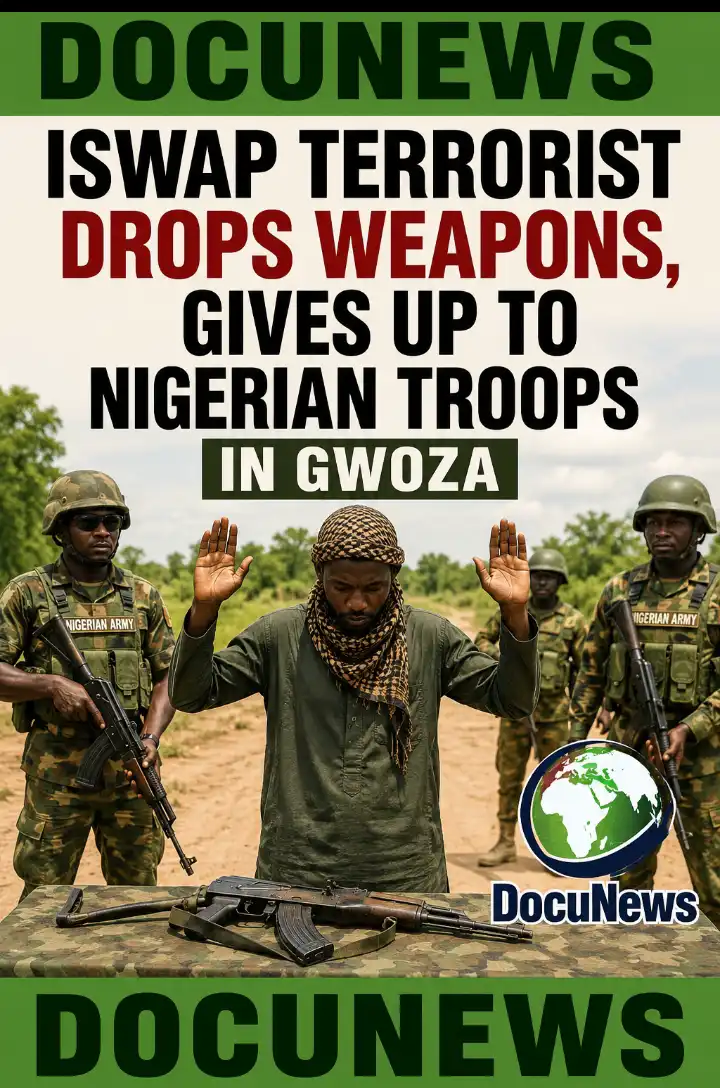
A suspected Islamic State West Africa Province (ISWAP) fighter has surrendered to troops of the Nigerian Army during ongoing military operations in Gwoza Local Government Area of Borno State. Military sources confirmed that the suspect voluntarily laid down his weapons before approaching soldiers stationed in the area.
The surrender marks another development in the ongoing counter-insurgency campaign in Nigeria’s North-East. Security officials said the latest defection reflects increasing operational pressure on terrorist groups operating within the Sambisa-Gwoza axis.
The incident happened on May 9, 2026, in Gwoza Local Government Area, Borno State, a long-standing conflict zone near Nigeria’s border with Cameroon. The area remains one of the most active military theaters in the country’s fight against insurgency.
What Happened in Gwoza?
The suspected ISWAP member reportedly approached Nigerian Army troops and surrendered without resistance. According to field reports, the individual dropped his weapon before making contact with soldiers during a routine military patrol.
Troops immediately secured the location and took the suspect into custody for screening and intelligence assessment. Military procedure requires detailed interrogation to determine the individual’s operational history and network connections.
Security personnel also recovered materials linked to the surrendered suspect. However, officials have not publicly disclosed the exact items collected during the operation.
Also read NDC Hands Presidential Ticket to South, Says North Will Take 2031
Where Did It Happen?
The surrender occurred in Gwoza, a strategic town in southern Borno State. Gwoza has remained central to Nigeria’s anti-terror operations because of its proximity to forest corridors historically used by insurgents.
The terrain around Gwoza presents significant security challenges. Mountains, forests, and difficult access routes have allowed terrorist groups to establish temporary hideouts in the past.
Because of that, the Nigerian military has maintained sustained operations across the region. Troops regularly conduct patrols, raids, and surveillance missions to prevent renewed terrorist activity.
Who Is Involved?
The surrendered individual is believed to be affiliated with ISWAP, one of the major insurgent factions active in North-East Nigeria. Authorities have not released the suspect’s identity pending further investigations.
The Nigerian Army confirmed that troops operating under ongoing counter-terrorism directives handled the surrender. Military officers said established procedures are being followed.
Intelligence teams are now expected to analyze information obtained from the suspect. Such intelligence often supports follow-up operations in surrounding areas.
Military Pressure on ISWAP Continues
Security analysts say recent military operations have increased pressure on insurgent groups. Sustained troop presence has disrupted movement corridors and reduced access to traditional supply routes.
As a result, some fighters have reportedly chosen to surrender instead of remaining in isolated camps. Military officials believe continued pressure could encourage more defections.
In recent months, Nigerian troops have intensified ground and air offensives across Borno, Yobe, and Adamawa states. These operations have targeted known terrorist enclaves and supply lines.
Several commanders have repeatedly stated that operational momentum remains strong. Consequently, military patrols continue in both urban and rural sectors.
You may have missed this TCN Workers Held Hostage in Kwara Substation Raid
Why Gwoza Remains Important
Gwoza remains strategically important because it borders routes historically used by insurgents moving between Nigeria and neighboring territories. Security agencies have repeatedly identified the area as a critical operational zone.
Earlier attacks in the region caused large-scale displacement. Therefore, authorities continue prioritizing military stabilization efforts there.
Community leaders in Gwoza have also supported military efforts through local intelligence sharing. Officials say civilian cooperation remains essential.
Defections and Intelligence Value
Military experts say surrendered fighters can provide operational intelligence. This may include information on leadership structures, planned attacks, and hidden weapons locations.
Therefore, each surrender creates both a security and intelligence opportunity. Authorities often use such information to plan precision operations.
However, all surrendered individuals undergo strict verification. Security agencies must determine whether the surrender is genuine and whether additional risks remain.
Regional Security Context
ISWAP has remained active in parts of North-East Nigeria despite years of military pressure. The group continues to attempt attacks on military positions and civilian communities.
Nevertheless, security agencies report gradual gains. More territories now remain under government control compared to previous years.
International security observers have also acknowledged improvements in regional military coordination. Joint patrols and intelligence sharing have expanded in recent years.
Still, authorities warn that the threat has not disappeared. Continuous vigilance remains necessary.
Government Response
Federal authorities have consistently pledged support for ongoing military operations in the North-East. Funding for logistics and troop deployment has continued.
Officials say rehabilitation pathways remain available for verified defectors. However, accountability processes remain part of national security policy.
Security officials have also urged residents to report suspicious movement promptly. Early reporting often improves operational response times.
What Happens Next?
The surrendered suspect is expected to undergo detailed screening by intelligence officers. Investigators will attempt to verify his claims and affiliations.
Meanwhile, military patrols in Gwoza continue. Commanders say operations will not slow because of a single surrender.
Instead, security officials describe the development as another step in a broader campaign aimed at weakening insurgent networks across the North-East.
For now, authorities say the mission remains unchanged: maintain pressure, protect communities, and prevent any resurgence of organized terrorist activity.
Additional official information is expected after military screening concludes.
For related official security updates, visit Security updates Nigeria and the Nigerian Army official website and the Federal Ministry of Defence.
